MikroTik E60IUGS 28069881 Review: For Network Tinkerers & Lab Builders
The MikroTik E60IUGS 28069881 is a compact wired router that delivers advanced RouterOS features, a 2.5G SFP port, and PoE support, best suited for technically inclined users and robust network deployments.
 By Elvis Dicki
Updated October 22, 2026
In the world of networking hardware, the MikroTik hEX S (2025) E60iUGS A occupies a unique niche. This compact, wired router is not a consumer plug-and-play device but a versatile platform built for those who want granular control over their network. It is designed for network enthusiasts, home lab builders, small businesses, and industrial applications where reliability and custom configuration are paramount. At its core, the MikroTik E60IUGS 28069881 combines a capable dual-core CPU with a flexible port selection, including a 2.5G SFP cage, all managed by the powerful RouterOS operating system.

This review analyzes the specifications, design, and user feedback for this router. We will examine its performance potential, the learning curve associated with its software, and the specific scenarios where it excels. For users seeking a silent, rugged, and highly configurable wired networking solution, the MikroTik hEX S presents a compelling option, provided they are prepared for its professional-grade interface.
Prime MikroTik hEX S E60iUGS 2.5G SFP Gigabit Router

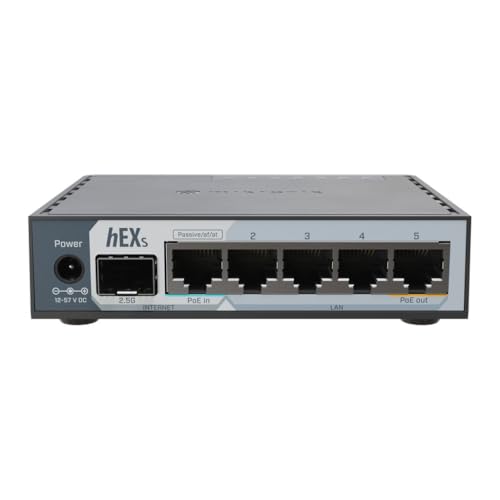
As an Amazon Associate we earn from qualifying purchases. Product prices and availability are accurate as of the date/time indicated.
MikroTik E60IUGS 28069881 at a Glance
| Specification | Detail |
|---|---|
| CPU | Dual-core ARM EN7562CT @ 950 MHz |
| RAM / Storage | 512 MB / 128 MB NAND |
| Operating System | RouterOS v7 (License Level 4) |
| Ethernet Ports | 5 x Gigabit (10/100/1000) |
| SFP Port | 1 x 2.5G supported |
| PoE Features | PoE-In (Passive, 18-57V), PoE-Out on Ether5 |
| USB Port | 1 x USB 3.0 Type-A (1A max current) |
| Power Input | DC Jack (12-57V) or Passive PoE-In |
| Cooling | Passive (Fanless) |
| Operating Temperature | -40°C to 70°C |
Design and Build
The MikroTik hEX S is built with a focus on durability and deployment flexibility. Its compact dimensions make it suitable for placement on a desk, in a network cabinet, or in more demanding environments. The unit relies entirely on passive cooling, meaning it operates silently, a significant advantage for office or home settings where noise is a concern. This design choice is backed by a wide operating temperature range, allowing it to function reliably in conditions from freezing cold to intense heat, which hints at its suitability for industrial or outdoor enclosures.
The build quality supports an IP20 rating, offering basic protection against solid objects but not against water. The front panel houses status LEDs, while the rear contains all connectivity ports, laid out in a logical order. The inclusion of dual power inputs—a standard DC jack and Passive PoE-In—provides flexibility for installation, especially in locations where running a separate power cable is impractical. The overall design is utilitarian and robust, prioritizing function and longevity over aesthetic flair.
Performance and Features
Hardware and Processing Power
At the heart of the MikroTik E60IUGS is an ARM-based dual-core EN7562CT CPU running at 950 MHz, paired with 512 MB of RAM. This hardware is designed to handle routing, firewall, and VPN tasks efficiently. A key performance feature noted in the specifications is IPsec hardware acceleration, which offloads the encryption/decryption processes from the main CPU. This is crucial for maintaining good throughput when using VPN connections. User reviews support this, with one owner noting significantly lower CPU usage compared to an older model, with their unit running at around 5% load during normal use.
Connectivity and Ports
Connectivity is where this router shows its versatility. The five Gigabit Ethernet ports provide ample connectivity for wired devices, servers, or connections to other switches. The standout feature is the single 2.5G SFP port, which allows for a high-speed fiber or DAC (Direct Attach Copper) connection to a compatible switch, server, or modem. This enables a multi-gigabit backbone for the network without needing to upgrade all ports to 2.5G. One Ethernet port (Ether5) supports PoE-Out, capable of powering a compatible device like an access point or security camera. The USB 3.0 port can be used for storage or a 3G/4G modem, though its current output is limited to 1 amp.
RouterOS Software
The true power of any MikroTik device lies in RouterOS. Version 7, which this model runs, is a full-featured network operating system. It provides extensive capabilities for routing, firewall, QoS, VPNs (including WireGuard), bandwidth management, and network monitoring. Configuration can be done via a web-based GUI (WebFig), a Windows application (WinBox), or a command-line interface (CLI). This flexibility is praised by experienced users who appreciate the depth of control. However, the interface and configuration logic have a steep learning curve for those unfamiliar with enterprise networking concepts. As highlighted in a critical review, some basic tasks may not be intuitive in the web interface and require alternative methods.
Setup, Support and Ownership
Setting up the MikroTik hEX S is not akin to setting up a typical home router. Out of the box, it requires technical knowledge to configure for most use cases beyond the default setup. The manufacturer provides a quick start guide, but comprehensive configuration relies on the user’s understanding of RouterOS or a willingness to learn using the extensive online wiki and community forums. Support is noted by users as being good, and the device’s software receives ongoing updates from MikroTik, adding features and security improvements over time.
Ownership is facilitated by the device’s reliability, evidenced by a high Mean Time Between Failures (MTBF) rating and its wide temperature tolerance. The lack of moving parts due to passive cooling contributes to long-term durability. The product comes with a one-year limited warranty. For those looking to expand, the USB port and SFP slot offer upgrade paths, such as adding cellular failover or a faster uplink. For more ideas on building capable network setups, explore our guide on the best routers for custom firmware.
What Owners Say
Owner feedback for the MikroTik E60IUGS 28069881 is predominantly positive, reflected in its overall rating. The majority of reviews award the highest rating, praising its power, features, and reliability. Users frequently describe it as an “amazing little router” with a “ton of features,” appreciating the ability to configure it via CLI, web GUI, or even a mobile phone. Many highlight its low resource consumption and strong firewall capabilities in the base configuration.
The critical reviews primarily center on the complexity of RouterOS. Some users express frustration with the setup process, citing non-intuitive steps for what they consider basic tasks, such as changing the IP address range. This underscores the product’s target audience: it is not designed for complete beginners but for those with some networking knowledge or a desire to delve deeper. The absence of any wireless functionality is also noted, which is a deliberate design choice for a dedicated wired router.
Pros and Cons
Pros
- Versatile port selection with 2.5G SFP and Gigabit Ethernet
- PoE-In and PoE-Out support for flexible deployment and power
- Extremely robust operating temperature range and silent passive cooling
- Powerful RouterOS software with deep configuration options
- Efficient performance with IPsec hardware acceleration
- Compact and durable build quality
Cons
- RouterOS interface has a significant learning curve
- No built-in Wi-Fi, requiring separate access points
- USB port current output is limited
- Some basic configuration steps can be non-intuitive in the web interface
- Not designed for users seeking a simple plug-and-play experience
Who Should Buy It (and Who Should Skip It)
The MikroTik E60IUGS 28069881 is an ideal choice for network enthusiasts, students learning enterprise networking, home lab builders, and small to medium businesses needing a reliable, configurable wired router. It is perfect for users who require VPN capabilities, advanced firewall rules, or a multi-gigabit backbone via SFP. Its ruggedness also makes it suitable for industrial or remote deployments. If you enjoy tinkering with network settings and want a device that won’t limit your configuration options, this router is for you. For those building complex home networks, our resource on the best routers for large homes may offer additional context.
Conversely, you should skip this router if you need simple setup for basic home internet sharing with Wi-Fi. It is not suitable for users unwilling to learn a new and complex operating system. Those looking for an all-in-one wireless solution should consider a traditional wireless router instead. If your primary interest is in compact, silent computing rather than networking, you might find our reviews of fanless mini PCs more relevant.
Final Verdict
The MikroTik hEX S (2025) E60iUGS A is a specialized tool that excels in its intended roles. It delivers exceptional value through its hardware features—the 2.5G SFP port, PoE flexibility, wide temperature tolerance, and capable processor. These specs are bundled in a compact, silent, and durable chassis. For the right user, it represents a gateway to professional-grade network management without the professional-grade price tag often associated with such feature sets.
However, its greatest strength is also its biggest barrier: RouterOS. This review concludes that the router’s performance and potential are unquestionable, but they are fully unlocked only with technical expertise. It is highly recommended for lab environments, learning platforms, and deployments where control and reliability are critical. For the casual user seeking simplicity, it is likely the wrong tool for the job. It stands as a testament to the principle that powerful networking doesn’t require a large footprint, just a willing mind to configure it. For other high-performance networking needs, such as handling gigabit internet plans, see our analysis of the best routers for gigabit internet.
FAQs
Does the MikroTik hEX S have Wi-Fi?
No, the MikroTik E60IUGS 28069881 is a dedicated wired router and does not have any built-in wireless capabilities. To provide Wi-Fi, you would need to connect a separate wireless access point to one of its Ethernet ports. The PoE-Out functionality on port Ether5 can be used to power a compatible PoE access point.
Is this router good for beginners?
This router is generally not recommended for complete networking beginners. The RouterOS operating system has a steep learning curve and uses terminology and concepts from enterprise networking. While it is possible for a motivated beginner to learn, most will find consumer-grade routers with simpler interfaces more suitable for initial setup and use.
What can the 2.5G SFP port be used for?
The 2.5G SFP port allows for a high-speed network connection using an SFP module. You can use a fiber SFP module to connect over long distances, a DAC cable to connect to another SFP-equipped switch or server at short range, or possibly a 2.5G copper SFP module to connect to a device with a 2.5G Ethernet port. This provides a faster backbone link than the standard 1G Gigabit Ethernet ports.
What is the difference between PoE-In and PoE-Out on this device?
PoE-In refers to the device’s ability to receive power over Ethernet. The MikroTik hEX S can be powered via Passive PoE (18-57V) on its Ethernet port, eliminating the need for the separate DC power adapter in some deployments. PoE-Out refers to its ability to send power out on one specific Ethernet port (Ether5) to power another device, such as an access point or camera.
About the author

Elvis Dicki writes reviews and buying guides for CyberSecLabs.