Hcjyc CC1101 Review: Does Its 12dB Antenna Boost Range Beyond 2000 Feet?
The Hcjyc CC1101 is a plug-and-play external antenna that significantly extends the Sub-GHz transmission and receiving range of the Flipper Zero, making it a solid upgrade for dedicated wireless testing.
 By Elvis Dicki
Updated October 21, 2026
The Flipper Zero is a versatile multi-tool for security enthusiasts and hobbyists, but its built-in Sub-GHz capabilities have inherent range limitations. Enter the Hcjyc CC1101, an external antenna designed specifically to augment the Flipper Zero’s wireless reach. This accessory attaches directly to the device’s GPIO ports, aiming to transform it from a short-range tool into a more potent instrument for interacting with wireless signals. If you frequently use your Flipper Zero for long-distance signal transmission or need to capture weak signals from farther away, this compact board could be a critical add-on. In short, the Hcjyc CC1101 delivers a substantial, plug-and-play range extension for the Flipper Zero’s Sub-GHz functionality, though it does occupy key GPIO pins in the process.

This product is squarely aimed at Flipper Zero owners who have hit the limits of the onboard radio. Whether you’re conducting penetration tests on remote wireless systems, learning about radio frequency protocols, or simply exploring the capabilities of sub-gigahertz communication, an extended range is often a necessity. The Hcjyc CC1101 promises to meet that need with a tested transmission range beyond 2000 feet and enhanced receiving capabilities. As an accessory, it doesn’t require the Flipper Zero to be modified, sticking to a straightforward attachment philosophy. This review will analyze its design, the performance claims based on manufacturer specifications, and how it fits into a user’s toolkit, helping you decide if this range boost is worth the GPIO real estate it consumes.
Prime Flipper Zero CC1101 External Antenna



As an Amazon Associate we earn from qualifying purchases. Product prices and availability are accurate as of the date/time indicated.
Hcjyc CC1101 at a Glance
| Specification | Detail |
|---|---|
| Core Function | External CC1101 Antenna for Flipper Zero |
| Compatibility | Flipper Zero (device not included) |
| Connection | GPIO ports 1-8 (Plug-and-play) |
| Power | 5V (via Flipper Zero GPIO) |
| Key Performance Claim | Extended Transmission Range (tested 2000+ ft), Extended Receiving Range (tested 80+ ft) |
| Antenna Type | 12dB OMNI, 433MHz |
| Included Accessories | Portable protective stand |
| Build Quality Notes | Full-body chamfering, high-density 3D printed design |
| Warranty | 1 year |
Design and Build
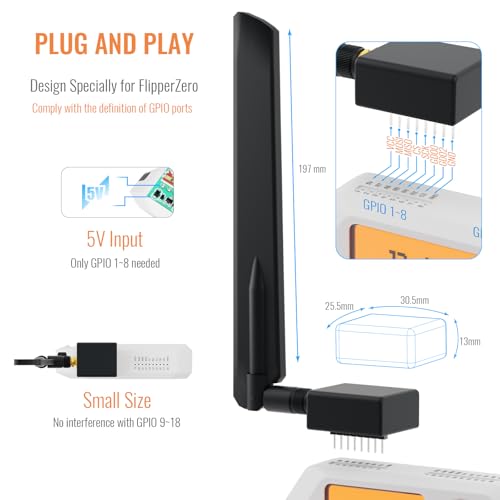
The Hcjyc CC1101 is designed with a clear purpose: to be a minimal-footprint, maximum-function add-on. The main board is compact, connecting only to GPIO pins 1 through 8 on the Flipper Zero. This selective connection is a deliberate design choice to prevent interference with the higher-numbered GPIO ports (9-18), leaving them free for other potential accessories or uses. The board itself appears utilitarian, housing the CC1101 transceiver module and the connection interface.
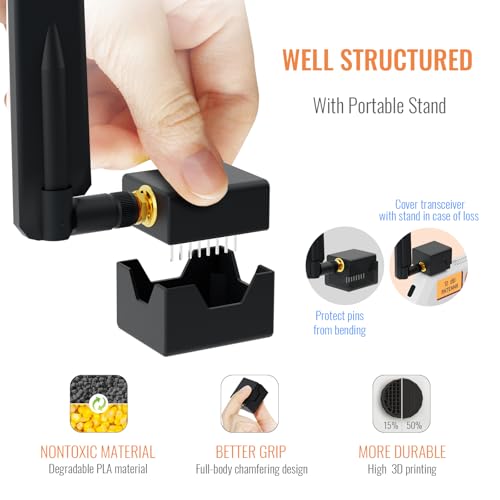
Beyond the board, the build package shows thoughtful consideration for practical ownership. A significant inclusion is the portable stand. This isn’t just a display piece; it serves multiple protective functions. When not attached to the Flipper Zero, the antenna board can be covered with this stand, shielding its pins from bending and preventing loss. The stand also acts as a grip when the antenna is in use, providing a more secure handling experience. The manufacturer notes a full-body chamfering design and the use of high-density 3D printing, which aims to enhance durability for everyday use and transport. The overall impression from the specifications is of an accessory built to be used in the field, not just left on a workbench.
Performance and Features
Range Extension Capabilities
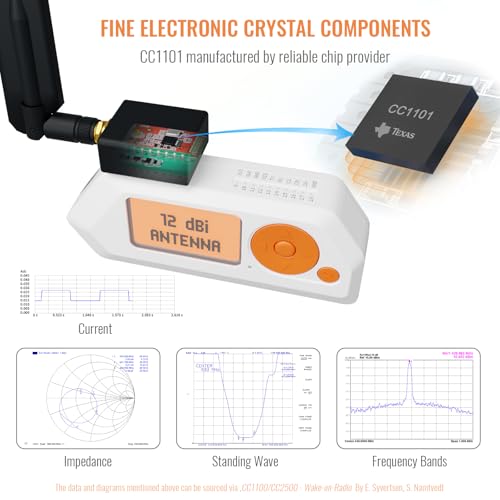
The primary reason to consider the Hcjyc CC1101 is its claimed performance boost. According to the manufacturer, this antenna extends the Flipper Zero’s transmission range to over 2000 feet in tested conditions. For receiving, it enhances the range to over 80 feet. These figures represent a substantial increase over the stock capabilities, enabling interactions with wireless devices from much greater distances. This makes tasks like testing long-range remote controls, accessing far-off sensors, or other Sub-GHz applications far more feasible. The performance hinges on the integrated 12dB gain omni-directional antenna tuned for 433MHz, a common frequency for many low-power wireless applications like garage door openers, weather stations, and some alarm systems.
Antenna and Frequency Focus
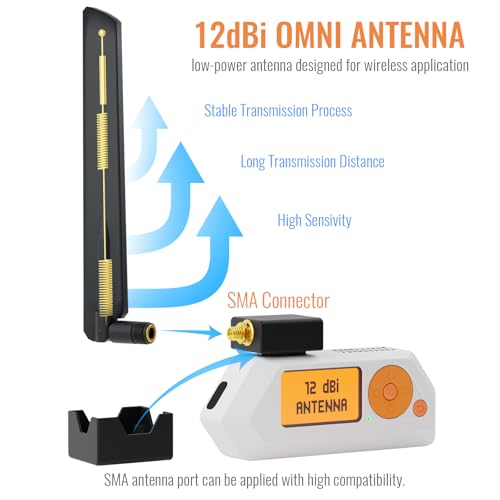
The included antenna is a 12dB omni-directional type. A higher dB gain generally means a stronger signal in a particular direction or pattern; an omni-directional pattern provides coverage in all horizontal directions. This antenna is specified for 433MHz operations. It’s important to note that this focus means the Hcjyc CC1101 is optimized for this specific slice of the Sub-GHz spectrum. While the Flipper Zero’s Sub-GHz module can work on other frequencies, the antenna’s performance will be best at its designed 433MHz center point. Users needing to frequently work with other Sub-GHz frequencies might find the antenna’s efficiency reduced outside its optimal band.
Plug-and-Play Connectivity
Ease of use is a major feature. The board requires no soldering, external batteries, or complex wiring. It draws 5V power directly from the Flipper Zero’s GPIO pins it connects to. Installation is ostensibly as simple as aligning the board’s connector with GPIO pins 1-8 on the Flipper Zero and pressing it into place. This plug-and-play philosophy greatly reduces the barrier to entry, making this performance upgrade accessible even to users who aren’t comfortable with hardware modification. However, this convenience comes with the trade-off of occupying those eight GPIO pins, which could otherwise be used for other expansions like a Wi-Fi dev board or a prototype board.
Setup, Support and Ownership
Setup for the Hcjyc CC1101 is described as straightforward, aligning with its plug-and-play design. Physically, it involves attaching the board to the Flipper Zero’s GPIO header. On the software side, the Flipper Zero’s firmware should recognize the external CC1101 module automatically when using Sub-GHz apps, though users may need to ensure they are running compatible firmware versions. The manufacturer provides a one-year warranty, offering a standard level of protection against defects in materials or workmanship.
As an accessory, the Hcjyc CC1101 does not function independently; it requires the Flipper Zero host device, which is sold separately. The product listing does not specify any additional software or driver requirements, nor does it mention firmware update support for the antenna board itself. Ownership is simplified by the included protective stand, which addresses the common issues of bent pins and lost small accessories. For users whose projects revolve around Sub-GHz capabilities, this antenna could become a semi-permanent attachment. For those who need to frequently swap between different GPIO accessories, the need to physically attach and detach the board is a consideration.
Interested in other ways to expand your Flipper Zero’s capabilities? Our comprehensive Flipper Zero tutorial covers a range of tips and accessory uses.
What Owners Say
Customer feedback for the Hcjyc CC1101 shows a generally positive reception, with the overall rating reflecting satisfaction with its core promise of extended range. The rating distribution indicates a high percentage of perfect scores, suggesting many users experienced the significant performance improvement they expected. A smaller portion of users gave mid-range ratings, which could relate to factors like specific frequency performance outside 433MHz, the physical fit, or the trade-off of using the GPIO pins. The limited number of lower scores suggests few encountered outright defects or complete failures. The consensus from the ratings implies that for users focused on enhancing 433MHz Sub-GHz range, this accessory delivers on its main claim.
Pros and Cons
Pros
- Massively extends transmission range beyond 2000 feet.
- Significantly improves receiving range for weak signals.
- True plug-and-play installation with no extra wiring.
- Compact design that doesn’t interfere with unused GPIO pins.
- Includes a practical protective stand for storage and grip.
- Durable, chamfered 3D-printed construction.
Cons
- Occupies GPIO pins 1-8, blocking other accessories.
- Requires the separate purchase of a Flipper Zero.
- Performance is optimized for 433MHz frequency.
- May require compatible Flipper Zero firmware.
- Adds bulk to the otherwise pocket-sized Flipper Zero.
- Specifics on compatibility with all Flipper Zero firmware variants are not listed.
Who Should Buy It (and Who Should Skip It)
The Hcjyc CC1101 is an ideal purchase for Flipper Zero owners who consistently find themselves needing more range from the Sub-GHz radio. This includes security professionals performing wireless assessments, hobbyists experimenting with long-range RF communication, or anyone using their Flipper Zero to interact with 433MHz devices like remote controls or sensors from a distance. If your primary use case revolves around the Sub-GHz functionality and you rarely use other GPIO accessories, this board is a logical and high-value upgrade.
Conversely, you should skip this accessory if your Flipper Zero usage rarely involves the Sub-GHz features, or if you heavily rely on other GPIO attachments like Wi-Fi or NFC boards. Users who primarily work with frequencies far from 433MHz may not see the full benefit of the optimized antenna. Also, if you prize the Flipper Zero’s pocket-friendly form factor above all else, the added bulk of this external board might be a drawback. For a broader look at tools for tech enthusiasts, explore our Tech Gear section.
Final Verdict
The Hcjyc CC1101 succeeds in its fundamental mission: to be a simple, effective range extender for the Flipper Zero’s Sub-GHz operations. By leveraging an external, higher-gain antenna and the CC1101 transceiver, it addresses a common limitation of the base device. The plug-and-play design makes this advanced capability accessible, while the thoughtful inclusion of a protective stand shows an understanding of real-world user needs. The performance claims, if met in practice, transform the Flipper Zero from a short-range tool into a much more potent device for wireless interaction.
However, this capability comes with a clear trade-off: the commitment of eight GPIO pins. This makes the Hcjyc CC1101 best suited as a semi-permanent attachment for users whose focus is squarely on Sub-GHz applications. It is less ideal for those who frequently switch between different hardware expansions. For its target audience—Flipper Zero users who need reliable, long-distance 433MHz communication—this accessory is a compelling and well-executed upgrade that significantly expands the device’s utility. For more insights into cybersecurity tools and learning, check out our main Blog page.
FAQs
Does the Hcjyc CC1101 work with all Flipper Zero models?
The product is designed specifically for the Flipper Zero and connects to its standard GPIO header. It should be compatible with all standard Flipper Zero devices that have the exposed GPIO pins. The manufacturer does not list any exceptions for specific hardware revisions, but as with any accessory, ensuring your device’s firmware is up to date is recommended for full compatibility.
Can I use this antenna for frequencies other than 433MHz?
The included 12dB omni-directional antenna is optimized for 433MHz operations. While the Flipper Zero’s Sub-GHz app may allow you to transmit and receive on other frequencies with this board attached, the antenna’s performance and efficiency will likely be reduced outside its designed frequency band. For optimal results, it is best used within the 433MHz range.
Do I need any extra software or drivers to make it work?
The product description states a plug-and-play design, implying no extra drivers are needed. The Flipper Zero’s existing Sub-GHz application should interface with the external CC1101 module automatically once it is physically connected. No additional software is mentioned by the manufacturer as being required.
What happens to GPIO pins 9-18 when this board is attached?
A key design feature noted by the manufacturer is that the board only connects to GPIO pins 1 through 8. It is specifically engineered not to interfere with pins 9 through 18. This means those higher-numbered pins remain free and accessible, allowing users to potentially stack or use other accessories that do not require the pins occupied by the CC1101 board.
About the author

Elvis Dicki writes reviews and buying guides for CyberSecLabs.