GMKtec EVO-X2 Review: A Desktop-Class APU in Mini Form
The GMKtec EVO-X2 delivers exceptional local AI processing and multi-display power in a compact chassis, making it ideal for developers and power users.
 By Elvis Dicki
Updated October 20, 2026
The GMKtec EVO-X2 represents a significant leap in mini PC capability, centered around AMD’s top-tier Ryzen AI Max+ 395 APU. This system is engineered for users who demand serious computational power for artificial intelligence workloads, content creation, and multi-monitor productivity from a small footprint. It is not a general-purpose office PC but a specialized machine targeting developers, data scientists, and creative professionals who need to run large language models locally or drive expansive visual workspaces. With its soldered 128GB of ultra-fast memory and integrated graphics that rival discrete mobile GPUs, the EVO-X2 offers a unique blend of miniaturization and raw performance.

This review analyzes the specifications, design, and intended use cases of the GMKtec EVO-X2 to determine who will benefit most from its advanced feature set. The bottom line is that this mini PC excels in providing desktop-class AI and graphics performance in a compact form factor, making it a compelling choice for a specific, high-end user segment that prioritizes local processing power and connectivity over upgradeability.
GMKtec EVO-X2 Ryzen AI Max+ 395 Mini PC 128GB


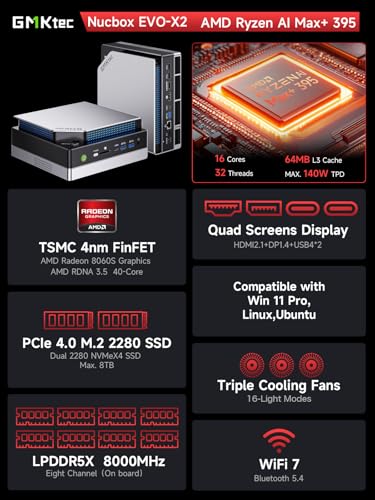

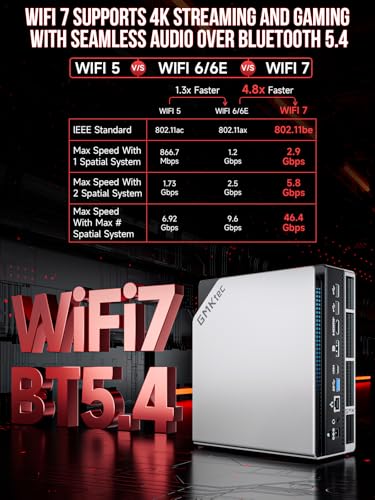
As an Amazon Associate we earn from qualifying purchases. Product prices and availability are accurate as of the date/time indicated.
GMKtec EVO-X2 at a Glance
| Specification | Detail |
|---|---|
| Processor | AMD Ryzen AI Max+ 395 (16 cores, 32 threads, up to 5.1GHz) |
| Graphics | AMD Radeon 8060S iGPU (40 RDNA 3.5 Cores) |
| AI NPU | XDNA 2 Architecture, 50+ peak AI TOPS |
| Memory | 128GB Eight-Channel LPDDR5X 8000MHz (soldered) |
| Storage | 2TB PCIe 4.0 M.2 SSD, Dual M.2 2280 slots for expansion |
| Video Output | Quad Display: HDMI 2.1 (8K@60Hz), DP 1.4, 2x USB4 (DP 1.4 alt mode) |
| Connectivity | Wi-Fi 7, Bluetooth 5.4, 2.5GbE LAN |
| Cooling | Triple-fan system with three heat pipes and RGB lighting |
| Power Modes | Quiet (54W), Balanced (85W), Performance (140W) |
| Operating System | Windows 11 Pro |
Design and Build
The GMKtec EVO-X2 adopts a silver metal chassis, a common choice for mini PCs that aids in heat dissipation and provides a premium feel. Its design prioritizes function, housing a sophisticated triple-fan cooling system to manage the thermal output of the high-performance Ryzen AI Max+ 395 APU. This system includes dual turbo fans for the CPU, a separate fan for cooling the memory and SSD, and three advanced heat pipes. The manufacturer states this setup enables quiet operation at 35dB in its lowest power mode. A distinctive feature is the inclusion of 13 RGB lighting modes for the cooling fan, controllable via a dedicated button on the chassis, allowing for personalization.
Physical controls are straightforward, with dedicated buttons for switching performance modes and cycling through the fan lighting. The build is focused on housing the powerful, soldered components in a stable thermal environment rather than emphasizing user access for upgrades, as the high-speed LPDDR5X memory is permanently installed on the board. The overall design communicates that this is a performance-first device where internal space is optimized for cooling the substantial integrated silicon.
Performance and Features
Processing and AI Capabilities
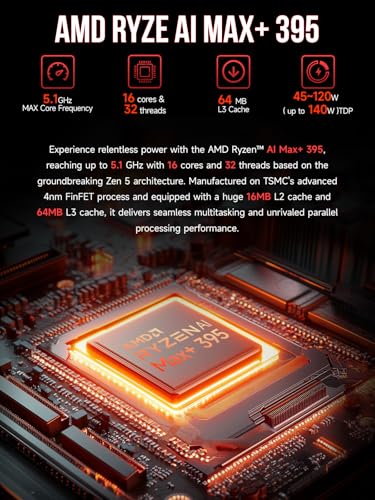
At the heart of the EVO-X2 is the AMD Ryzen AI Max+ 395, described by the manufacturer as the most powerful x86 APU on the market for AI computing. This 16-core, 32-thread processor is built on a 4nm process and features a large 64MB L3 cache. Its key differentiator is the integrated XDNA 2 Neural Processing Unit (NPU), rated for over 50 peak AI TOPS. This hardware is designed to accelerate consumer AI workloads locally, such as running language models in applications like LM Studio. The substantial 128GB of system memory is crucial here, as it provides the necessary pool for large models; the manufacturer specifically notes the system can run a Deepseek 70B Q8 model comfortably.
Graphics and Gaming
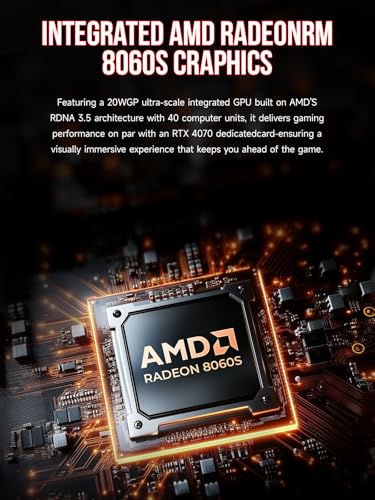
The integrated AMD Radeon 8060S graphics, with 40 compute units based on the RDNA 3.5 architecture, is a major selling point. Manufacturer positioning places its performance between laptop-grade RTX 4060 and 4070 GPUs. This enables gaming at 1080p resolution with high detail settings in demanding titles. A significant advantage for both gaming and AI is the ability to allocate a very large portion of the system RAM as VRAM through AMD software, with the manufacturer citing up to 96GB. This vast memory allocation benefits not only high-resolution texture loads in games but is also perfect for memory-intensive large language model inference.
Connectivity and Expandability
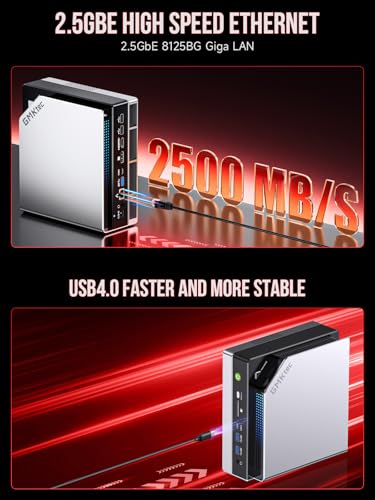
Connectivity is a standout area. The EVO-X2 supports a quad-screen output setup, enabling users to drive four displays simultaneously. This is achieved via one HDMI 2.1 port (supporting 8K at 60Hz), one DisplayPort 1.4, and two USB4 ports that support DisplayPort 1.4 alt mode and 40Gbps data transfer. This makes the system ideal for video editing, financial trading, or any workflow requiring extensive screen real estate. For networking, it includes both cutting-edge Wi-Fi 7 for theoretical multi-gigabit wireless speeds and a 2.5 Gigabit Ethernet port for wired applications like network-attached storage or soft routing. Additional ports include three USB 3.2 Gen2 ports, two USB 2.0 ports, a 3.5mm audio combo jack, and an SD 4.0 card reader.
Storage expansion is well-supported with dual M.2 2280 PCIe 4.0 slots, allowing users to add significant fast storage alongside the pre-installed 2TB SSD. The system memory, however, is not upgradable as it uses soldered LPDDR5X modules. This eight-channel memory configuration is noted by the manufacturer to offer significant performance benefits over standard DDR5 SODIMMs in applications like video conferencing and productivity tasks.
Software and Performance Modes
The device ships with Windows 11 Pro, which includes standard security features like Windows Defender and Windows Firewall. A key usability feature is the hardware-based triple performance mode switch. Users can toggle between Quiet (54W), Balanced (85W), and Performance (140W) modes directly with a button on the chassis, without entering the BIOS. This allows immediate adjustment of the system’s power envelope, cooling noise, and performance to suit the task at hand, from silent media playback to maximum-performance AI model training.
Setup, Support and Ownership
Setup for the GMKtec EVO-X2 should be straightforward for anyone familiar with desktop computing, involving connecting peripherals and power. The included accessories are a power adapter, an HDMI cable, and a user manual. The power adapter is a substantial 330W unit, indicating the system’s potential power draw, especially in its 140W Performance mode. For users looking to expand capabilities, the dual M.2 slots provide a clear path for adding more NVMe storage. Other upgrades are limited due to the integrated nature of the core components.
GMKtec provides a one-year limited warranty covering defects in design and workmanship from the date of purchase. The manufacturer mentions a professional after-sales team for support. As with any specialized hardware, long-term ownership will depend on driver support from AMD for the novel APU and iGPU, as well as ongoing BIOS/UEFI updates from GMKtec to ensure stability and compatibility. Users interested in similar high-performance computing options for AI can explore resources like our guide on the best computer servers for AI research.
What Owners Say
Based on the available rating distribution, the GMKtec EVO-X2 has been received positively by the majority of owners. A significant portion of reviewers awarded the highest rating, indicating satisfaction with performance, features, or both. A smaller but notable group gave four-star ratings, suggesting a very good experience with minor reservations. Critical ratings are present in a minority of reviews, which is common for complex, high-performance hardware where individual experiences with setup, specific workloads, or expectations can vary. The overall rating reflects a product that delivers on its core promises for most users in its target audience.
Pros and Cons
Pros
- Exceptional AI processing power with a dedicated 50+ TOPS NPU
- Desktop-class integrated graphics performance rivaling mobile GPUs
- Massive 128GB of ultra-fast eight-channel LPDDR5X memory
- Comprehensive connectivity with quad 8K display support, Wi-Fi 7, and USB4
- Effective triple-fan cooling system with user-selectable performance modes
- Convenient hardware buttons for power modes and RGB lighting control
Cons
- Soldered RAM prevents any future memory upgrades
- High power consumption in performance mode requires robust power delivery
- Premium cost and specification may be excessive for basic computing tasks
- Thermal and acoustic management is critical for a chassis of this size
- Dependent on integrated components with no path for GPU or CPU upgrade
- Niche focus makes it less suitable for general office or home theater use
Who Should Buy It (and Who Should Skip It)
The GMKtec EVO-X2 is ideally suited for developers, researchers, and creative professionals who need to run large language models or other AI inference tasks locally without relying on cloud services. Its combination of a powerful NPU and vast, fast memory is tailored for this. It is also an excellent choice for users who require a compact yet powerful machine to drive a multi-monitor workstation for video editing, data visualization, or software development. Enthusiasts looking for a small-form-factor gaming PC capable of 1080p gaming will also find it compelling. For more insights into compact AI systems, consider reading our overview of AI mini PCs.
This mini PC is not recommended for users with standard computing needs like web browsing, document editing, or media consumption. Its cost and capabilities are overkill for such tasks. Users who prioritize long-term upgradeability for components like RAM or GPU should look to traditional desktop towers. Those with strict budgets or who do not have workloads that leverage the specific AI, graphics, or multi-display strengths of the EVO-X2 should skip it in favor of more conventional mini PCs or laptops.
Final Verdict
The GMKtec EVO-X2 is a remarkable technical achievement, successfully packaging what is essentially a high-end desktop APU with workstation-level memory into a mini PC form factor. It decisively carves out a niche for users who need maximum local AI computational power and graphics performance in a small, discreet chassis. The thoughtful inclusion of cutting-edge connectivity like Wi-Fi 7, USB4, and quad-display support future-proofs the system and adds tremendous value for professional setups. While the soldered memory is a trade-off for speed and compactness, it provides the essential resource pool for the demanding workloads this machine is built to handle.
Ultimately, the EVO-X2 justifies its position for a specific audience. It is not a general-purpose device but a specialized tool. For developers working on local LLMs, professionals managing complex multi-screen workflows, or enthusiasts wanting a potent yet small gaming and creation station, the GMKtec EVO-X2 offers a combination of features that is currently unique in the mini PC market. Its performance comes with considerations for power and thermal management, but for its target user, it represents a compelling and highly integrated solution. You can find more expert analysis on high-performance computing in our reviews section.
FAQs
Can the RAM in the GMKtec EVO-X2 be upgraded?
No, the 128GB of LPDDR5X memory is soldered directly onto the motherboard and cannot be upgraded or replaced by the user. This design is typical for LPDDR (Low-Power Double Data Rate) memory, which is used for its high speed and power efficiency in compact devices. The configuration is fixed as eight channels of 16GB each.
What kind of AI applications can this mini PC run?
The EVO-X2 is designed to run consumer AI workloads locally, leveraging its dedicated XDNA 2 NPU and large system memory. The manufacturer specifically mentions compatibility with applications like LM Studio for running large language models. It is cited as being capable of running models such as Deepseek 70B Q8, making it suitable for local AI inference, coding assistants, and other generative AI tasks without needing an internet connection to cloud services.
How many monitors can I connect, and at what resolution?
You can connect up to four monitors simultaneously. This is supported through a combination of ports: one HDMI 2.1 port supporting 8K resolution at 60Hz, one DisplayPort 1.4 port supporting 4K at 60Hz, and two USB4 ports that each support DisplayPort 1.4 alternate mode. This allows for a mixed setup of ultra-high-resolution and high-refresh-rate displays, ideal for immersive workspaces.
Is the GMKtec EVO-X2 good for gaming?
Yes, for 1080p gaming. The integrated AMD Radeon 8060S graphics is positioned by the manufacturer as performing between a laptop RTX 4060 and RTX 4070 GPU. This level of performance enables playing modern, demanding games at 1080p resolution with high or maximum detail settings. The ability to allocate a large portion of the system’s 128GB RAM as VRAM (up to 96GB) is also beneficial for games with high-resolution texture packs.
About the author

Elvis Dicki writes reviews and buying guides for CyberSecLabs.