GMKtec EVO-X2 Review: 128GB LPDDR5X AI Mini PC
The GMKtec EVO-X2 is a uniquely configured mini PC with exceptional RAM capacity and AI NPU acceleration, designed for running large language models locally and handling demanding creative workloads in a compact form factor.
 By Elvis Dicki
Updated October 22, 2026
In the evolving landscape of compact computing, the GMKtec EVO-X2 carves out a distinct niche. This mini PC is built around AMD’s cutting-edge Ryzen AI Max+ 395 APU, but its defining characteristic is an extraordinary 128GB of LPDDR5X RAM, a specification rarely seen in systems of this size. It is engineered for a specific user: the professional or enthusiast who needs to run substantial local AI models, such as large language models (LLMs), while also demanding strong integrated graphics performance for gaming or content creation, all from a device that occupies minimal desk space. The bottom line is that the EVO-X2 offers a compelling, space-efficient solution for heavy AI workloads and multitasking, though it requires some technical consideration to unlock its full potential.

This review analyzes the specifications, design, and real-world feedback for the GMKtec EVO-X2 to determine if its unique blend of high-capacity memory and integrated AI acceleration lives up to its promise. We will examine its performance capabilities for AI tasks and gaming, its extensive connectivity, and the practicalities of ownership based on user experiences. For those exploring the intersection of compact PCs and AI computing, our guide on AI mini PCs provides broader context for this specialized category.
GMKtec EVO-X2 Ryzen AI Max+ 395 Mini PC 128GB



As an Amazon Associate we earn from qualifying purchases. Product prices and availability are accurate as of the date/time indicated.
GMKtec EVO-X2 at a Glance
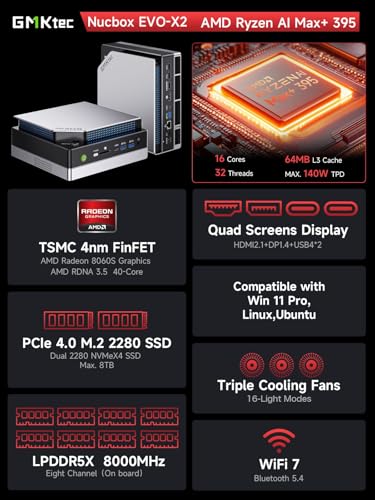
| Processor (APU) | AMD Ryzen AI Max+ 395 (16 cores / 32 threads, up to 5.1 GHz) |
|---|---|
| Graphics (iGPU) | AMD Radeon 8060S with 40 RDNA 3.5 CUs |
| AI NPU | XDNA 2 Architecture, 50+ peak AI TOPS |
| Memory | 128GB LPDDR5X 8000MHz (8-channel, soldered) |
| Storage | 2TB PCIe 4.0 NVMe SSD (Dual M.2 slots, up to 8TB total) |
| Video Output | Quad Display via HDMI 2.1 (8K), DP 1.4, Dual USB4 |
| Connectivity | Wi-Fi 7, Bluetooth 5.4, 2.5GbE LAN |
| Cooling | Triple fan system with heatpipes and RGB lighting |
| Power Modes | Quiet (54W), Balanced (85W), Performance (140W) |
Design and Build
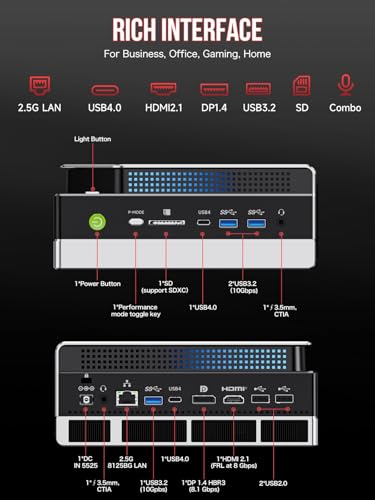
The GMKtec EVO-X2 adopts the classic mini PC form factor, prioritizing a small physical footprint. It features a silver metal chassis, which aids in heat dissipation and provides a premium, sturdy feel. The front panel is utilitarian, housing various ports and two buttons: one for cycling through 13 RGB lighting modes for the internal fans and a dedicated button for switching between the three performance modes. This hardware-based mode switch is a notable convenience, allowing users to adjust the thermal and power profile without entering the BIOS.
Cooling is a significant focus of the design. GMKtec employs a triple-fan solution consisting of dual turbo fans for the CPU and a separate fan dedicated to cooling the LPDDR5X memory and SSD. This is supplemented by three advanced heatpipes and a 360-degree airflow design. The manufacturer claims this system keeps the unit frosty under heavy loads while operating at just 35dB in Quiet Mode. The inclusion of RGB lighting on the fans adds a customizable aesthetic element, though its utility is purely visual. The build quality, as noted in user reviews, is generally considered good, contributing to the product’s positive reception for its physical construction.
Performance and Features
Processing, AI, and Graphics Power
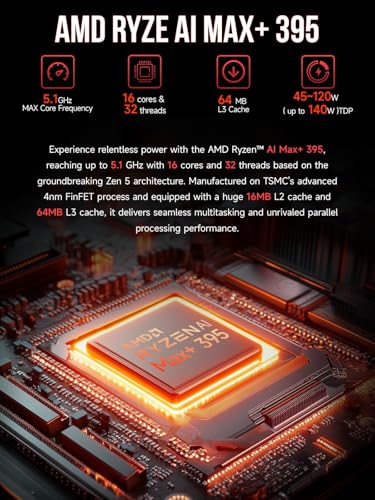
At the heart of the EVO-X2 is the AMD Ryzen AI Max+ 395, a 16-core/32-thread APU built on a 4nm process. With a boost clock up to 5.1 GHz and 64MB of L3 cache, it provides substantial compute power for multitasking and productivity applications. The transformative feature is the integrated XDNA 2 Neural Processing Unit (NPU), rated for over 50 peak AI TOPS. This NPU is designed to accelerate consumer AI workloads efficiently. The manufacturer highlights its performance with applications like LM Studio, which allows users to run LLMs locally without deep technical knowledge. The APU’s integrated graphics, the Radeon 8060S, is based on the RDNA 3.5 architecture with 40 compute units. Performance is positioned between laptop-grade RTX 4060 and 4070 GPUs, enabling smooth gaming at 1080p with high details in demanding titles.
The 128GB LPDDR5X Advantage
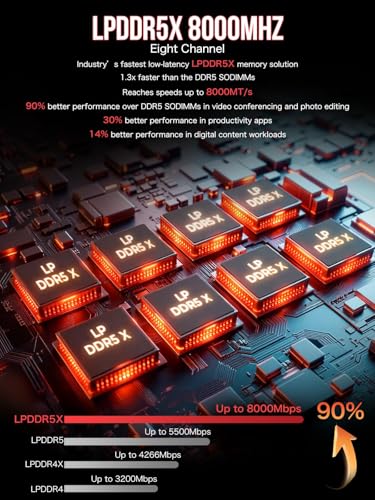
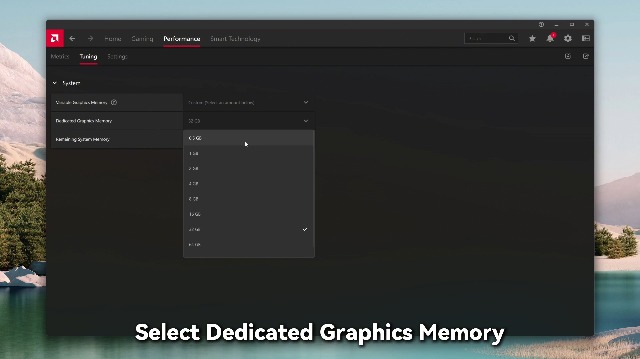
The most standout specification is the 128GB of LPDDR5X memory running at 8000MT/s in an eight-channel configuration. This soldered memory is not user-replaceable but offers significant bandwidth advantages. According to the manufacturer, it runs 1.5x faster than standard DDR5 SODIMMs and can provide up to 90% better performance in tasks like video conferencing and photo editing. For AI workloads, this massive, fast memory pool is critical. The iGPU can also utilize this pool, with AMD software allowing VRAM allocation up to 96GB. This is essential for running large language models like Deepseek 70B Q8 locally, a key selling point for the device. However, user experiences indicate that fully leveraging all 128GB for AI models may be more straightforward under Linux than Windows.
Connectivity and Expandability
The EVO-X2 is exceptionally well-connected. For displays, it supports a quad-screen setup through a combination of HDMI 2.1 (8K@60Hz), DisplayPort 1.4 (4K@60Hz), and two USB4 ports (40Gbps, supporting DisplayPort 1.4 and Power Delivery). This makes it suitable for immersive multitasking, video editing, or financial trading setups. Network connectivity is future-proofed with Wi-Fi 7 and a 2.5 Gigabit Ethernet port, useful for network storage or soft routing applications. The port selection is comprehensive: three USB 3.2 Gen 2 ports, two USB 2.0 ports, two 3.5mm audio jacks, and an SD 4.0 card reader supporting UHS-II cards for fast media transfer. Storage expansion is handled by dual M.2 2280 PCIe 4.0 slots, supporting up to 4TB each for a theoretical maximum of 8TB total capacity. For insights into deploying such hardware in research settings, see our analysis of the best high-performance servers for AI applications.
Setup, Support and Ownership
The GMKtec EVO-X2 typically ships with Windows 11 pre-installed, which should allow for a quick out-of-the-box setup. Users report the initial physical setup is straightforward, thanks to the ample port selection and included HDMI cable. However, the post-setup experience regarding drivers and BIOS can be challenging. Multiple user reviews cite difficulty in locating specific drivers from GMKtec, with downloads sometimes failing or being incomplete. Updating the BIOS or tweaking advanced settings is also described as a non-trivial process, indicating that software support is an area where GMKtec could improve.
The device comes with a one-year limited warranty from GMKtec, covering defects due to design and workmanship. There is no detailed information on the availability or quality of technical support beyond the warranty statement. For users comfortable with troubleshooting or considering alternative operating systems like Linux for AI work, these support limitations may be a manageable hurdle. The hardware itself, aside from the RAM, offers some upgradeability through the dual M.2 storage slots, but the core CPU, GPU, and memory are fixed. More general computing topics and reviews can be found in our Tech Gear section.
What Owners Say
Overall owner sentiment is positive, reflected in its rating distribution where the majority of reviews are five-star. Buyers frequently praise the impressive specifications for the price, the quality of the build, and the compact size. Many highlight its capability as a powerful, space-efficient main machine or server. The ability to run large AI models locally is a major draw, with one user successfully running 120B parameter models on Ubuntu, though they noted Windows imposed limitations on memory allocation for AI tasks.
Critical feedback centers on a few key areas. Some users express frustration that the 128GB of RAM is split between system and GPU memory by default, wishing for more user control over allocation. The most common critique concerns software and driver support, described as subpar and difficult to navigate. There are also mentions of fan noise, particularly an audible whine, becoming noticeable when the system is under load in higher performance modes. A small segment of users felt the high cost was not justified if the unique RAM configuration did not align with their specific use case.
Pros and Cons
Pros
- Exceptional 128GB LPDDR5X RAM enables running massive local AI models.
- Powerful AMD Ryzen AI Max+ 395 APU with dedicated 50+ TOPS NPU.
- Strong integrated graphics performance suitable for 1080p gaming.
- Extensive connectivity including Wi-Fi 7, 2.5GbE, dual USB4, and SD 4.0 reader.
- Compact metal chassis with effective triple-fan cooling system.
- Convenient hardware button for switching between three performance modes.
Cons
- BIOS and driver support can be difficult to access and update.
- Fan noise may become noticeable in performance mode.
- Windows may limit full RAM utilization for some AI tasks compared to Linux.
- High memory capacity may not be utilized by all users, affecting value perception.
- Soldered RAM prevents future memory upgrades.
- Software control over memory allocation between system and GPU could be more flexible.
Who Should Buy It (and Who Should Skip It)
The GMKtec EVO-X2 is an ideal fit for a specific audience. Developers, researchers, or enthusiasts who need to run large language models or other memory-intensive AI workloads locally will find its 128GB RAM and NPU acceleration incredibly valuable. It’s also a great choice for power users who want a compact, clean desktop for heavy multitasking across multiple high-resolution displays, content creation, and respectable 1080p gaming, all in one tiny box. Users with space constraints but high performance demands, such as those setting up a compact home lab or media server, should also consider it.
This mini PC is not recommended for the average user or typical office computer replacement. Its high-cost configuration is overkill for web browsing, document editing, and media consumption. Gamers solely focused on high-refresh-rate 1440p or 4K gaming would be better served by a traditional desktop with a discrete graphics card. Furthermore, buyers who are not comfortable with potential driver hassles or tweaking settings between operating systems to maximize hardware potential may find the ownership experience frustrating. For those whose work intersects with security, foundational knowledge is key; resources in our Cybersecurity category may be of interest.
Final Verdict
The GMKtec EVO-X2 is a specialized tool that excels in its niche. It successfully packages top-tier mobile APU performance, groundbreaking integrated graphics, and a colossal amount of fast memory into a mini PC form factor. Its ability to handle local LLM inference and other AI tasks that typically require much larger systems is its most compelling attribute. When combined with versatile connectivity and a robust cooling design, it presents a unique proposition for the right user.
However, this capability comes with caveats. The value proposition hinges entirely on needing its massive RAM and AI acceleration; otherwise, it is an expensive mini PC. Ownership requires a degree of technical willingness to navigate driver support and potentially optimize the software environment to harness the hardware fully. If your workflow demands local AI processing power in a small package and you are prepared for its quirks, the EVO-X2 is a formidable and almost peerless option. For general use, more conventional and affordable mini PCs will suffice.
FAQs
Can the 128GB of RAM be upgraded or replaced?
No, the 128GB of LPDDR5X memory is soldered directly onto the motherboard in an eight-channel configuration. It is not user-replaceable or upgradeable. This is a fixed specification for the life of the device, so buyers should be confident that 128GB meets their long-term needs.
Is this mini PC good for gaming?
Yes, for 1080p gaming. The integrated AMD Radeon 8060S graphics, with 40 RDNA 3.5 compute units, delivers performance positioned between a laptop RTX 4060 and RTX 4070. This means it can run most demanding games at 1080p resolution with high or maximum detail settings at playable frame rates. It is not intended for competitive high-refresh-rate gaming or maxed-out 1440p/4K gaming.
What is the main advantage of the AI NPU?
The dedicated XDNA 2 Neural Processing Unit (NPU) provides efficient hardware acceleration for AI workloads. This can significantly speed up tasks like running local large language models (e.g., via LM Studio), AI-assisted features in creative software, and other machine learning inference tasks while consuming less power and freeing up the CPU and GPU for other operations.
How does performance mode affect the system?
The EVO-X2 features three user-selectable performance modes: Quiet (54W), Balanced (85W), and Performance (140W). Switching to Performance Mode increases the power limit (TDP) of the APU, allowing the CPU and GPU to sustain higher clock speeds under heavy loads, which boosts performance in demanding applications and games. The trade-off is increased heat output and fan noise, as the cooling system works harder. Quiet Mode prioritizes acoustics and lower power consumption, while Balanced Mode seeks a middle ground.
About the author

Elvis Dicki writes reviews and buying guides for CyberSecLabs.