GMKtec EVO-X1 Review: An AI Mini PC with OCuLink & Triple 8K
The GMKtec EVO-X1 AI Mini PC delivers exceptional AI processing power and strong integrated graphics in a compact form factor, making it a versatile choice for developers, gamers, and creators.
 By Elvis Dicki
Updated October 21, 2026
The GMKtec EVO-X1 AI Mini PC represents a significant leap forward in compact computing, packing AMD’s latest Ryzen AI 9 HX-370 processor into a chassis not much larger than a book. This device is engineered for users who demand desktop-level performance for AI development, content creation, and gaming but require a minimal physical footprint. With its advanced Neural Processing Unit (NPU), high-speed OCuLink connectivity, and support for triple 8K displays, the EVO-X1 targets a niche of power users seeking to replace or augment a traditional tower. The bottom line is that this mini PC offers a compelling blend of cutting-edge AI acceleration and versatile connectivity in a surprisingly small package.

For AI developers, the integrated XDNA 2 architecture NPU promises to accelerate machine learning workloads locally. Gamers and creators will appreciate the potent Radeon 890M integrated graphics and the unique OCuLink port for potential external GPU expansion. Its design also suits roles as a compact workstation, media server, or network appliance, thanks to dual 2.5G Ethernet ports. While its onboard memory limits future upgrades, its out-of-the-box configuration with 32GB of fast LPDDR5X RAM and a 1TB PCIe 4.0 SSD is robust for most demanding tasks.
GMKtec EVO-X1 AI Mini PC: Ryzen AI 9 HX 370



As an Amazon Associate we earn from qualifying purchases. Product prices and availability are accurate as of the date/time indicated.
GMKtec EVO-X1 at a Glance
| Specification | Detail |
|---|---|
| Processor | AMD Ryzen AI 9 HX-370 (Zen 5, up to 5.1GHz) |
| AI NPU | XDNA 2 Architecture, up to 50 TOPS |
| Integrated Graphics | AMD Radeon 890M (RDNA 3.5) |
| Memory | 32GB LPDDR5X-8000 (Onboard) |
| Storage | 1TB PCIe 4.0 NVMe SSD |
| Display Output | Triple 8K via HDMI 2.1, DP 2.1, USB4 |
| Special Port | OCuLink (PCIe x4) |
| Networking | Dual Intel i226-V 2.5GbE, WiFi 6, Bluetooth 5.2 |
| Operating System | Windows 11 Pro |
| Cooling | Dual Fan Hyper Ice Chamber 2.0 |
Design and Build
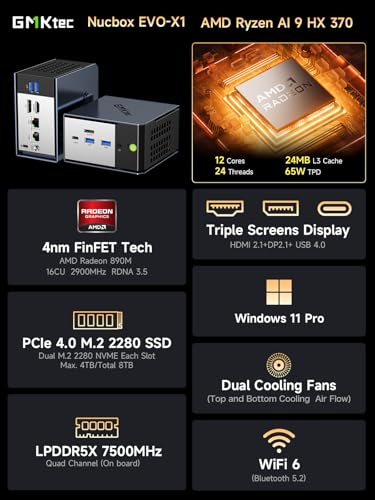
The GMKtec EVO-X1 adopts a minimalist, rectangular design typical of performance-oriented mini PCs. Its construction prioritizes efficient thermal management, which is critical for a system with a peak power consumption of 65 watts. The standout feature of the build is the upgraded Hyper Ice Chamber 2.0 cooling system. This design employs larger top and bottom cooling fans to create a 360-degree airflow path, pulling cool air in and expelling heat effectively. A copper base aids in heat dissipation from the processor.
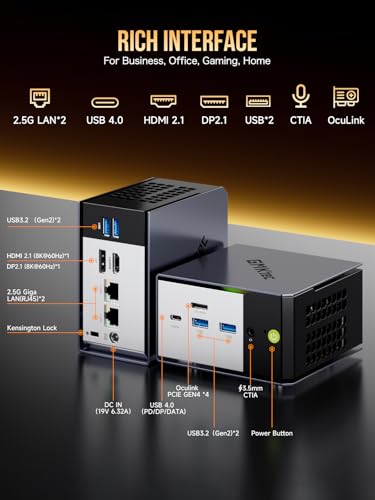
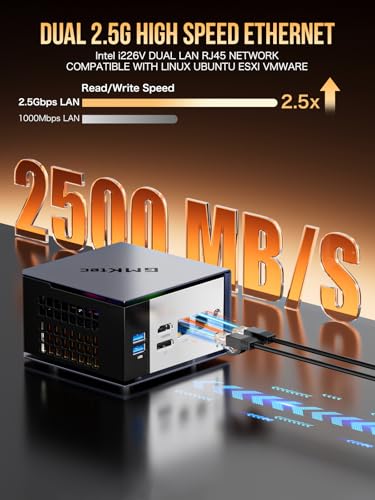
This focus on cooling allows the system to offer three user-selectable performance modes: Quiet (35W), Balance (54W), and Performance (65W). In Quiet mode, the manufacturer states fan noise is reduced to 35dB, making it suitable for office or living room environments where silence is valued. The physical port layout is comprehensive, with the notable OCuLink connector positioned alongside more common USB4, HDMI, and DisplayPort outputs. The inclusion of dual 2.5 Gigabit Ethernet ports on the rear is a boon for networking applications, hinting at its capability to serve as a firewall, router, or network-attached storage device.
Performance and Features
Processing and AI Power
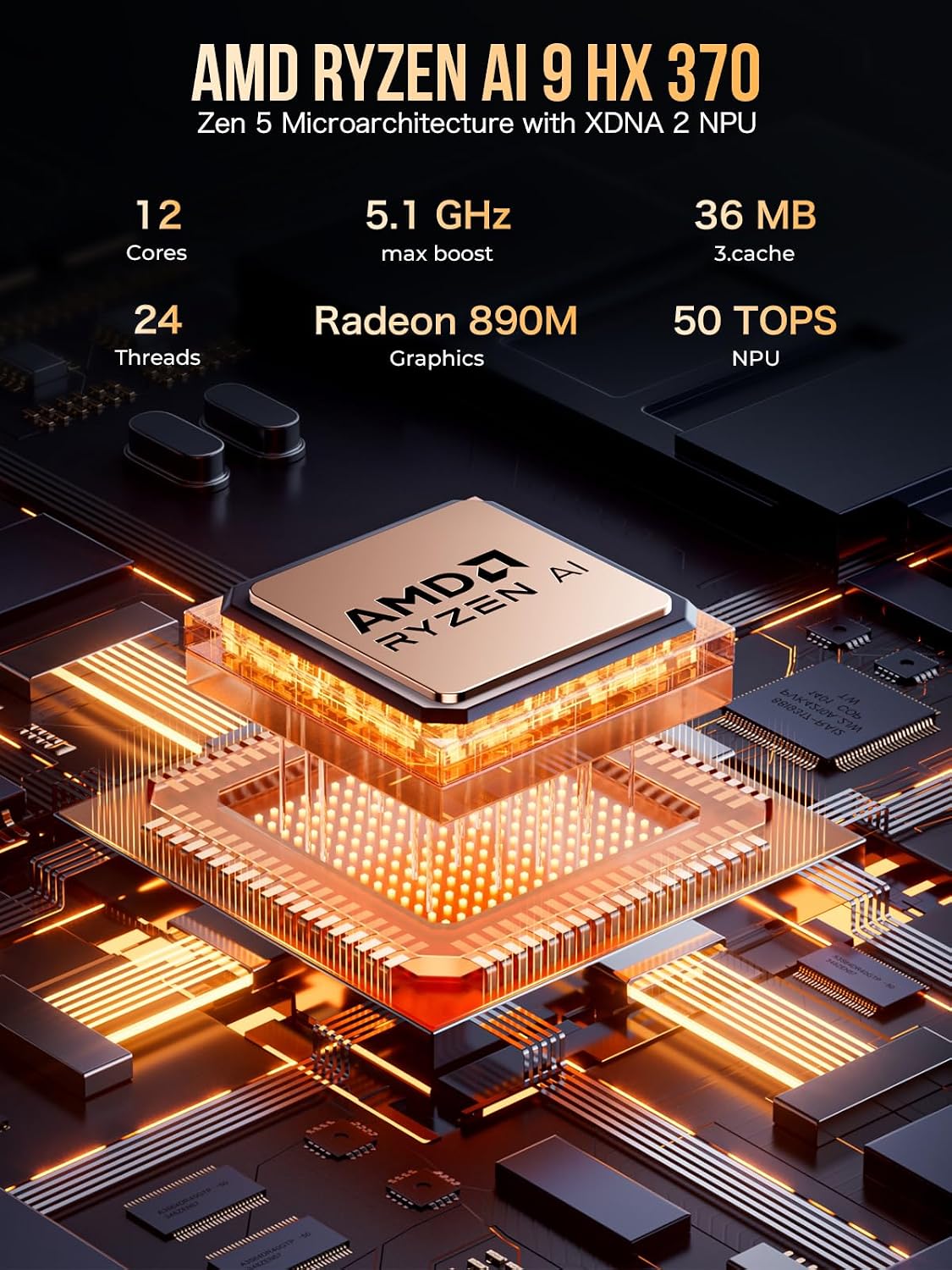
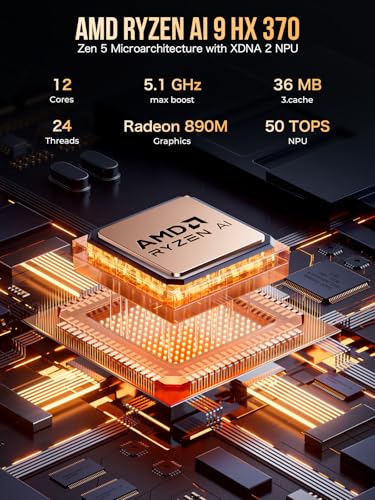
At the heart of the EVO-X1 is the AMD Ryzen AI 9 HX-370, a processor from the new “Strix Point” series that marks the debut of the Zen 5 microarchitecture for mobile platforms. With a boost clock speed of up to 5.1GHz and a 24MB cache, it provides the raw CPU performance for demanding multitasking and productivity applications. The true differentiator, however, is the integrated AI Neural Processing Unit (NPU) based on the XDNA 2 architecture. This dedicated AI engine is rated for up to 50 TOPS (Tera Operations Per Second), which the manufacturer states offers up to 30% better performance than previous-generation mobile processors.
This NPU is optimized for accelerating AI inference tasks such as image recognition, natural language processing, and deep learning models directly on the device. For developers and professionals working with local AI models, this means potentially faster iteration times and the ability to run more complex workloads without relying on cloud services. The NPU’s 16-bit precision and hardware acceleration are designed to make AI computations both efficient and fast.
Graphics and Gaming
The integrated graphics solution is the AMD Radeon 890M, based on the RDNA 3.5 architecture. This represents a significant generational leap in integrated graphics performance. According to the manufacturer’s data, the Radeon 890M outperforms the previous-generation Radeon 780M by up to 57% in some games. This level of performance positions the EVO-X1 as a viable mini PC for gaming at 1080p and potentially 1440p resolutions for many titles, eliminating the immediate need for a discrete graphics card for casual and moderate gamers.
The graphics capability is further enhanced by the system’s support for triple 8K display output. Users can drive three monitors simultaneously at 8K resolution (60Hz) via the HDMI 2.1 port, DisplayPort 2.1 port, and the USB4 port (which supports DisplayPort 1.4 Alt Mode). This makes the system exceptionally well-suited for video editors, financial traders, or anyone who benefits from an expansive multi-monitor workspace with extremely high resolution.
Memory, Storage, and Connectivity
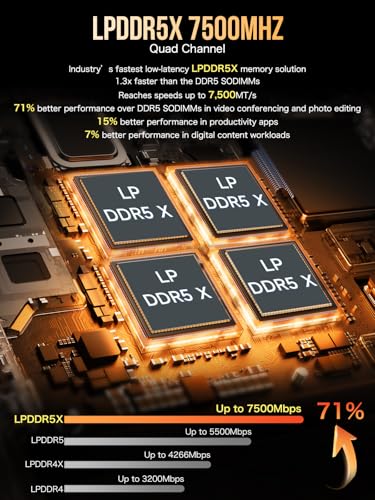
The EVO-X1 is configured with 32GB of LPDDR5X memory soldered directly onto the board. This quad-channel memory operates at speeds up to 8000MT/s. The manufacturer claims it runs 1.3x faster than standard DDR5 SODIMMs, with performance benefits including 76% better performance in video conferencing and photo editing, 15% better in productivity apps, and 7% better in digital content creation workloads compared to DDR5 SODIMMs. The trade-off for this speed is the lack of user-upgradability for RAM. For storage, it includes a 1TB PCIe 4.0 NVMe SSD, which offers fast boot and load times, and this SSD slot is likely user-upgradeable for future expansion.
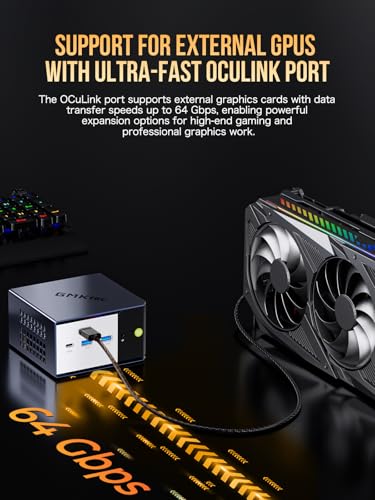
Connectivity is a major strength. Beyond the standard USB ports and audio jacks, the EVO-X1 features a USB4 port with 40Gbps transfer speeds, supporting power delivery, DisplayPort, and data. The most unique port is the OCuLink connector. This port provides a direct PCIe x4 connection, offering higher bandwidth than the more common Thunderbolt 3/4 (which typically uses PCIe x3). For users with compatible external GPU enclosures, OCuLink can mean better performance and lower latency, making it a compelling feature for gamers and creators who might want to add a high-end desktop GPU later. The dual 2.5 Gigabit Intel LAN ports, WiFi 6, and Bluetooth 5.2 round out a comprehensive networking suite.
Setup, Support and Ownership
Setup for the GMKtec EVO-X1 is straightforward, as it comes pre-installed with Windows 11 Pro. Users primarily need to complete the Windows out-of-box experience, install their preferred applications, and connect their peripherals. The UEFI (BIOS) has been updated and includes options for the three performance modes, VRAM allocation for the integrated graphics, and features like Auto Power On and Wake-on-LAN, which are useful for server or always-on applications.
Upgrade options are somewhat limited by the design. The LPDDR5X memory is onboard and not user-replaceable, so the 32GB configuration is fixed for the life of the device. The M.2 NVMe SSD slot should allow for storage upgrades or additions, and the OCuLink port opens the door for adding an external GPU or other PCIe devices. GMKtec offers a standard one-year limited warranty covering defects in design and workmanship, with support from a professional after-sales team. For those interested in exploring other compact computing options, our guides on fanless mini PCs and gaming mini PCs provide useful context.
What Owners Say
Overall owner feedback for the GMKtec EVO-X1 is positive, reflected in its aggregate rating. Users frequently highlight the impressive performance delivered by the new Ryzen AI 9 HX-370 processor and the Radeon 890M graphics, noting its capability for both productivity tasks and gaming. The compact size and the inclusion of the OCuLink port are also commonly praised as standout features that differentiate it from other mini PCs on the market.
Some reviews mention the effective cooling system, which manages to keep the system stable under load without excessive noise, particularly in the Balanced and Quiet modes. The versatility provided by the dual 2.5G Ethernet ports and triple display support is appreciated by users setting up home labs or multi-monitor workstations. While specific negative points from buyer reviews are not detailed in the provided data, the high aggregate rating suggests a generally satisfactory ownership experience. For comparisons with other AI-focused systems, our review of another AI mini PC offers additional insights.
Pros and Cons
Pros
- Exceptional AI processing power with the 50 TOPS XDNA 2 NPU
- Strong integrated Radeon 890M graphics for gaming and creation
- Unique OCuLink port for high-bandwidth external device support
- Versatile connectivity with triple 8K display, USB4, and dual 2.5GbE
- Fast quad-channel LPDDR5X-8000 memory performance
- Effective and relatively quiet dual-fan cooling system
Cons
- Onboard LPDDR5X memory is not user-upgradeable
- Peak 65W power draw requires adequate ventilation
- The benefits of the OCuLink port are most relevant to a niche user base
- Windows 11 Pro is the listed OS; other OS compatibility is not specified
- Lack of a dedicated graphics card limits maximum gaming performance
Who Should Buy It (and Who Should Skip It)
The GMKtec EVO-X1 AI Mini PC is an ideal fit for several specific user groups. AI developers and machine learning enthusiasts who want to run and test models locally will benefit greatly from the powerful NPU. Content creators and professionals needing a compact, yet powerful workstation for video editing, 3D rendering, or complex multitasking across multiple high-resolution monitors will find its performance and display outputs compelling. Gamers seeking a small-form-factor PC capable of handling modern titles at good settings, especially those interested in the eGPU potential of OCuLink, should strongly consider it. It’s also excellent for tech enthusiasts building a home server, network appliance, or home theater PC due to its dual NICs and quiet operation modes.
This mini PC may not be the best choice for users on a very tight budget who do not need its AI or high-end graphics capabilities. Those who require extensive, future-proof RAM upgrades beyond 32GB should look for systems with socketed memory. Users who need the absolute maximum gaming performance and plan to use high-end desktop GPUs from the outset might still be better served by a traditional mini-ITX tower build, despite the OCuLink advantage. For those seeking simpler, more budget-friendly options, our roundup of mini PCs at various price points can help.
Final Verdict
The GMKtec EVO-X1 is a remarkably forward-thinking mini PC that successfully integrates AMD’s latest mobile technologies. It isn’t just an incremental update; it’s a platform built for emerging workloads, particularly in AI, while still excelling at traditional tasks like gaming and content creation. The combination of the Zen 5 CPU, XDNA 2 NPU, and RDNA 3.5 graphics creates a versatile performance profile rarely seen in such a small form factor. The inclusion of the OCuLink port is a bold and pragmatic choice that offers a tangible performance path for expansion, setting it apart from competitors reliant solely on Thunderbolt.
While the decision to use fast, soldered LPDDR5X memory prioritizes performance over upgradability, the 32GB/1TB starting configuration is ample for its target audience. The comprehensive cooling design ensures the hardware can sustain its performance. For anyone needing a powerful, compact computer that is ready for both today’s demanding applications and tomorrow’s AI-enhanced software, the GMKtec EVO-X1 stands as a compelling and uniquely capable option in the crowded mini PC market.
FAQs
What is the OCuLink port used for?
The OCuLink port on the EVO-X1 provides a direct PCI Express x4 connection. Its primary use is for connecting an external graphics card (eGPU) enclosure, offering higher potential bandwidth and lower latency compared to standard Thunderbolt 3/4 connections. This can significantly boost gaming and creative application performance. It can also be used for other high-speed PCIe devices, such as fast storage arrays or specialized capture cards.
Can the RAM be upgraded later?
No, the 32GB of LPDDR5X memory is soldered onto the motherboard and is not user-upgradeable. This design choice allows for the very high memory speeds (up to 8000MT/s) and compact form factor but means you cannot add more RAM after purchase. The system does include a 1TB PCIe 4.0 SSD, which is typically in a standard M.2 slot and should be upgradeable.
Is this mini PC good for gaming?
Yes, thanks to the integrated AMD Radeon 890M graphics. The manufacturer states it outperforms the previous generation Radeon 780M by up to 57% in some games, making it one of the most powerful integrated graphics solutions available. It is capable of smooth gaming at 1080p and even 1440p for many titles. For users seeking maximum performance, the OCuLink port allows for the addition of a powerful desktop-grade external GPU.
What are the three performance modes?
The EVO-X1 features three configurable performance modes selectable via the BIOS/UEFI: Quiet (35W), Balance (54W), and Performance (65W). The Quiet mode prioritizes low noise (down to 35dB) and lower power consumption for basic tasks. Balance mode offers a good mix of performance and noise for everyday use. Performance mode unlocks the full 65W power limit of the processor for maximum CPU and GPU performance during demanding workloads like rendering, AI training, or gaming.
About the author

Elvis Dicki writes reviews and buying guides for CyberSecLabs.