DGA Domain Detection with Machine Learning: A Practical DNS Monitoring Guide
Learn how DNS monitoring detects malware domains. Explore DGA detection using machine learning models like LSTM and Random Forest, and see how a lab pipeline captures, analyzes, and alerts on malicious traffic.
 By admin
Updated October 29, 2026
In modern network security, few data sources are as ubiquitous and revealing as Domain Name System (DNS) traffic. It is the internet’s phonebook, translating human-readable domain names into IP addresses. This fundamental role also makes it a prime target for abuse by threat actors. Malware families leverage DNS for resilient command-and-control (C2) communication, often using sophisticated algorithms to evade detection. This creates a critical challenge for defenders: how can you spot the malicious needles in the vast, legitimate haystack of DNS queries? The answer increasingly lies in machine learning. This guide explores a practical approach to building a DNS monitoring system designed to detect domains generated algorithmically by malware, known as Domain Generation Algorithms (DGAs). You will learn why DNS is a crucial attack surface, how DGAs work, what features expose them, and how a complete pipeline—from collection to alerting—can be constructed and evaluated in a lab environment.
All lab work described should be conducted only in authorized, isolated environments disconnected from production networks.
DNS: The Critical but Vulnerable Foundation
DNS is a foundational protocol that is rarely blocked, making its traffic a goldmine for network security monitoring. Attackers exploit this necessity for various malicious purposes, primarily under the MITRE ATT&CK framework. Technique T1071.004 details the use of DNS as an application layer protocol for C2 communication. More specifically, adversaries employ Domain Generation Algorithms (DGAs), mapped to technique T1568.002, to generate a large number of potential domain names. This allows malware to establish contact with a C2 server even if security tools block previously known malicious domains. By algorithmically creating new domains—often daily—malware maintains a resilient and evasive communication channel.
How Domain Generation Algorithms Work
DGAs are pieces of code embedded within malware. They create domains algorithmically, which the malware then attempts to resolve to find its operational C2 server. These algorithms fall into several categories. Deterministic DGAs use a reproducible seed, such as the current date, allowing both the malware and its controller to generate the same list of domains independently. Non-deterministic DGAs produce more random outputs. The formats of the generated domains also vary, including:
- Random Strings: Collections of consonants or alphanumeric characters with no linguistic meaning (e.g., necurs, emotet).
- Word-list Combinations: Concatenations of dictionary words to mimic legitimate domains (e.g., suppobox, matsnu).
- Hexadecimal Hashes: Strings that appear as cryptographic hashes (e.g., bamital, ranbyus).
Understanding these types is the first step in recognizing the features that can be used to distinguish them from benign internet traffic.
Features That Expose DGA Domains
For a machine learning model to classify a domain as benign or malicious, it needs quantifiable data points, or features. Initial research focused on a set of five handcrafted features extracted from the Second-Level Domain (SLD)—the part just left of the dot, like “example” in “example.com.” These features were chosen because DGA domains often have anomalous characteristics compared to human-created domains.
| Feature | Description & Why It Matters |
|---|---|
| Label Length | The number of characters in the SLD. DGA domains can be unusually short or long. |
| Shannon Entropy | Measures the randomness of the character string. High entropy often indicates random generation. |
| Vowel-to-Consonant Ratio | The ratio of vowels (a, e, i, o, u) to consonants. Legitimate domains often have higher ratios for readability. |
| Digit Ratio | The proportion of digits in the string. An excessive number can be suspicious. |
| Distinct Character Ratio | The number of unique characters divided by the total length. High values suggest low repetition, common in random strings. |
Subsequent, more advanced work expanded this feature set to 28 mathematical and linguistic features, grouped into categories like structural morphology, information theory, phonetics, and linguistics. This included advanced metrics like Markov log-likelihood and dictionary match ratios, which proved more effective at detecting challenging word-list based DGAs.
Building the Detection Pipeline: From Collection to Alert
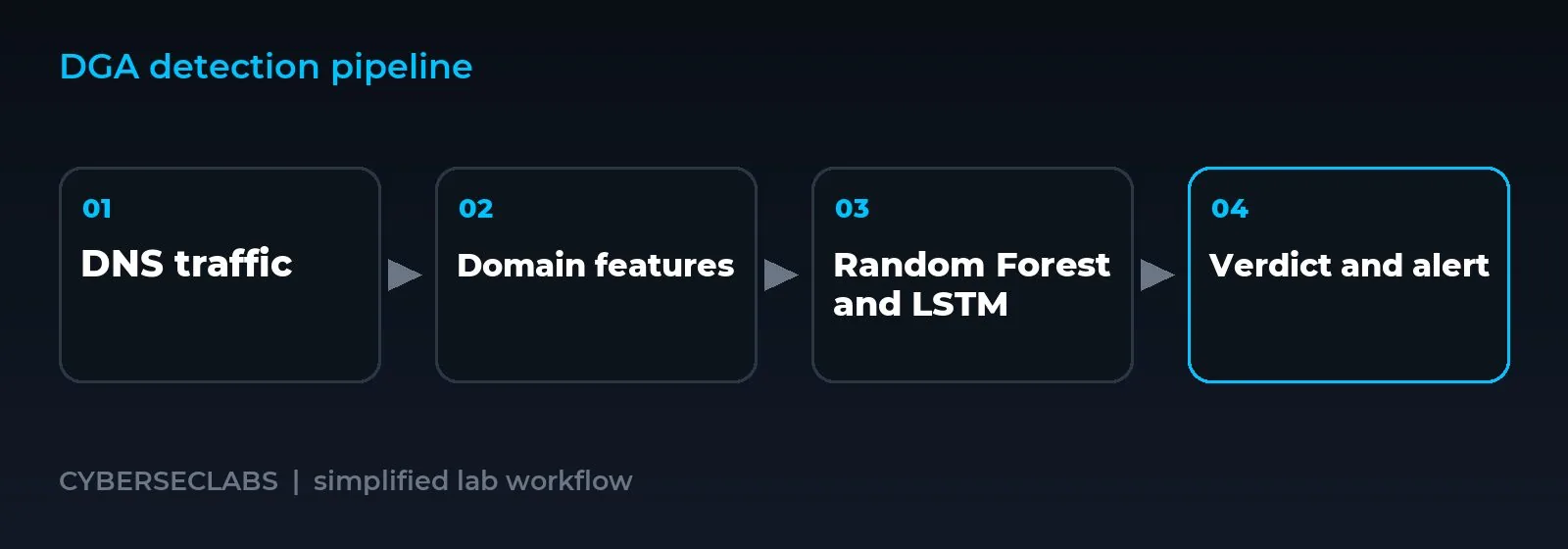
A practical DGA detection system is more than just a model; it’s an integrated pipeline. The lab project architected a four-stage process: Collection, Data Processing/Feature Extraction, Detection, and Alerting/Visualization.
Stage 1: Collection with Zeek
The pipeline begins by capturing raw network traffic. The system used the Zeek network security monitoring tool to passively observe DNS queries and responses. Zeek logs this activity to a standardized dns.log file, which serves as the input for the next stage. This approach is non-intrusive and leverages a tool widely used in security operations.
Stage 2: Processing and Feature Extraction
A Python-based processing module reads the Zeek logs, extracts the queried domain names, and parses them to isolate the SLD. It then cleans the data and computes the feature vector for each domain—whether the simple 5-feature set or the expanded 28-feature set—creating a structured dataset ready for classification.
Stage 3: The Machine Learning Detection Engine
This is the core of the system. The lab project trained and evaluated multiple models to find the most effective classifier. Key models tested included:
- Logistic Regression & SVM: Baseline models using the handcrafted features.
- Random Forest: An ensemble model that provided good interpretability, showing that length, vowel-consonant ratio, and entropy were the most important of the five features.
- LSTM (Long Short-Term Memory): A character-level deep learning model that processes the raw domain string as a sequence, learning patterns directly from the characters.
- Unified Attention-BiLSTM: An advanced model used in later enhancements that combined a character-sequence branch with a parallel branch analyzing the 28 mathematical features.
The LSTM emerged as the primary model due to its superior performance, compact size (373 KB), and strong generalization to unseen DGA families.
Stage 4: Alerting and the SOC Cockpit
When the model classifies a domain as malicious with high confidence, the system generates an alert. These alerts are fed into a real-time dashboard built with Streamlit, providing security analysts with a visual summary of detection statistics, threat counts, and detailed logs. An ancillary layer explored using a Large Language Model (LLM) to automatically draft human-readable detection rules based on alert patterns, though such drafts require analyst review.
Evaluating Model Performance and Generalization
Evaluating a detection model requires more than just a standard accuracy score on a balanced test set. The lab employed rigorous testing to understand real-world applicability.
Benchmark Results on Test Data
On a balanced test set of 400,000 domains (50% benign, 50% DGA), the LSTM model achieved an accuracy of 98.80%, with a precision of 99.23% and a recall of 98.36%. This translated to only 1,524 false positives and 3,283 false negatives. In comparison, the Random Forest model achieved 88.91% accuracy, with significantly higher false positive and false negative rates.
The Critical Generalization Test
A model that only detects malware families it has already seen is of limited use. To test generalization, a “leave-one-family-out” evaluation was conducted. Models were retrained excluding all domains from a specific DGA family and then tested on that held-out family. The results were revealing:
The LSTM generalized exceptionally well to unseen random-string families (like rovnix and emotet), maintaining recall above 99%. However, its performance dropped on more structured, seed-based families like banjori (Recall fell to 52.2%). Most critically, both LSTM and feature-based models nearly failed to detect unseen word-list DGA families like suppobox and matsnu. This underscores a key defensive insight: word-list DGAs pose the greatest detection challenge and require specialized features (like dictionary matching) or alternative detection methods.
Operational Scenarios and Advanced Integration
The system was validated through a series of lab scenarios simulating real network conditions. Scenario 1 established a baseline with benign traffic, confirming a low false positive rate. Scenario 2 introduced known DGA traffic, validating the detection capability. Scenario 3 mixed both traffic types, proving the system could filter malicious domains from a live stream. These scenarios used the Zeek-based pipeline.
Scenario 4: Proactive Defense with SOAR
An enhanced scenario demonstrated a move from detection to automated response. This iteration used a Scapy-based packet sensor, the unified Attention-BiLSTM model with 28 features, and a lightweight inference engine implemented in NumPy for speed. Most importantly, it integrated a SOAR (Security Orchestration, Automation, and Response) component. Upon detecting a DGA query storm from a host, the system could automatically inject an iptables rule to isolate that host in less than 5 milliseconds and redirect its web traffic to a warning sinkhole page. This showcased a fully functional Intrusion Prevention System (IPS) capable of near-instantaneous automated containment.
Practical Considerations for Deployment
Deploying such a system requires careful tuning and awareness of its boundaries. A crucial finding was that adjusting the model’s decision threshold has a dramatic impact on operational utility. For the LSTM, raising the threshold from the default 0.5 to approximately 0.97 reduced the false positive rate by 7.6x (from 0.76% to 0.10%) while only reducing recall from 98.4% to 95.4%. This trade-off is often necessary in real-world deployments where alert fatigue is a major concern.
Operational latency was also measured. While the model inference itself was fast (averaging under 80 ms per domain), the end-to-end latency, largely dictated by Zeek’s logging buffering, had a median of 1.12 seconds. The NumPy-based engine in the enhanced system reduced inference time to just 3.82 ms per domain. It is also vital to remember the system’s limitations: it is designed for unencrypted DNS (UDP port 53) and would require sensor placement at an internal resolver to monitor encrypted DNS (DoH/DoT). Furthermore, parsing domain suffixes relies on a list of top-level domains, which can incorrectly handle multi-level suffixes like .co.uk.
Key Takeaways
- Deep Learning Excels at DGA Detection: Character-level models like LSTM significantly outperform traditional machine learning models based on a small set of handcrafted features, offering higher accuracy and better generalization to unseen malware families.
- Generalization is Not Guaranteed: Models generalize well to unseen random-string DGA families but can fail catastrophically on unseen word-list-based families, which remain the hardest to detect.
- Threshold Tuning is Essential for Production: Adjusting the classification threshold is a critical step to balance detection rate (recall) with false alarm rate, making the system operationally viable.
- A Complete Pipeline is More Than a Model: Effective monitoring requires integrating reliable collection (Zeek/Scapy), efficient feature extraction, a robust detection model, and a clear alerting/visualization interface.
- Automated Response is Achievable: Integrating detection with SOAR principles allows for rapid, automated containment of infected hosts, moving from passive monitoring to active prevention.
Frequently Asked Questions
Related reading: Random Forest vs LSTM for DGA Detection: Generalizing to Unseen Malware Families
Why is DNS traffic so important for detecting malware?
DNS is a fundamental and rarely blocked protocol, making it a necessary channel for almost all internet-connected malware. By monitoring DNS queries, defenders can identify suspicious patterns, such as attempts to resolve algorithmically generated domains, which are a hallmark of advanced malware trying to establish resilient command-and-control channels. It provides visibility into malicious activity even before a connection to a malicious IP is established.
What’s the difference between using Random Forest and LSTM for DGA detection?
Random Forest is a traditional machine learning model that requires handcrafted features (like domain length and entropy). It is more interpretable, as you can see which features drive decisions, but its detection and generalization performance are lower. An LSTM is a deep learning model that learns directly from the raw sequence of characters in a domain name. It typically achieves much higher accuracy and generalizes better to new DGA variants, acting more like a pattern recognition engine for the structure of the string itself.
Can this system detect all types of DGA domains?
No system is perfect. This approach is highly effective at detecting DGA families that generate random or semi-random strings (like Necurs or Emotet). Its primary weakness is in detecting word-list-based DGA families (like Suppobox), which generate domains that look like concatenated legitimate words. Detecting these requires more sophisticated linguistic features or alternative methods, as they are designed to closely mimic benign traffic.
How would encrypted DNS (DoH/DoT) affect this monitoring?
Encrypted DNS poses a significant challenge to network-based monitoring. If clients use DNS-over-HTTPS (DoH) or DNS-over-TLS (DoT) directly to external resolvers, the plaintext DNS queries are no longer visible to a sensor on the local network. To maintain visibility, organizations would need to deploy the monitoring sensor at the endpoint itself, at a mandated internal DNS resolver that decrypts the traffic, or use other network-based traffic analysis techniques that don’t rely on inspecting packet payloads.
About the author

admin writes reviews and buying guides for CyberSecLabs.