The 5 Best Voc And Radon Indoor Air Quality Monitors of 2026
Indoor air can hide voc and radon until you have a monitor. The best voc and radon indoor air quality monitors in 2026 offer accurate readings, clear alerts, and easy setup for home use.
 By Daniel Okafor
Updated November 5, 2026

Worried about invisible pollutants in your home? Many people struggle with poor indoor air quality, which can trigger allergies, cause headaches, and even pose long-term health risks from silent threats like radon gas. When choosing an air quality monitor, the key decisions revolve around which specific contaminants you need to track, especially VOCs and radon, and how you prefer to access the data, whether through a simple display or a detailed smartphone app.

After analyzing the market, we recommend the 16 in 1 Air Quality Monitor Indoor 7″ Wildfire CO2 as the best overall pick for most households due to its comprehensive sensor suite and large display. For those deeply integrated into the smart home ecosystem, the Amazon Smart Air Quality Monitor – Know your air offers seamless Alexa integration. For more on smart home tech, explore our Tech Gear category.
The 3 Best Voc And Radon Indoor Air Quality Monitors on Our Shortlist (November 2026)
- Best for: Comprehensive multi-parameter monitoring
- Display: 7-inch LED
- Sensors: 16-in-1 detection
- Alerts: 7 distinct AQI buzzers

- Best for: Professional-grade radon detection
- Connectivity: WiFi & App
- Sensors: 7 always-on sensors
- Design: Cable-free eInk screen

- Best for: Alexa smart home integration
- Setup: Plug-and-play
- Automation: Routines with compatible devices
- Metrics: 5 key factors
This post may contain affiliate links. As an Amazon Associate we earn from qualifying purchases.
Quick Comparison
| Award | Product | CSL Score About CSL ScoreThe CSL Score is our own rating from 0 to 10, based on performance, design and build, ease of use, and value. It reflects independent research and is never influenced by manufacturers, retailers, or affiliate commissions. Learn more › | |
|---|---|---|---|
| Best Overall |
YNAK 16 in 1 Air Quality Monitor 7 Inch Display
|
9.6/10 | Check price |
| Best Value |
 Temtop M10+ 6-in-1 CO2 Air Monitor |
8.3/10 | Check price |
| Best Budget |
Amazon Smart Air Quality Monitor with Alexa
|
9.5/10 | Check price |
| Best Premium |
 BREATHE Airmonitor Plus CO2 NDIR PM TVOC |
9.4/10 | Check price |
| Top Rated |
Airthings 2960 View Plus 7-Sensor Monitor
|
7.8/10 | Check price |
YNAK 16 in 1 Air Quality Monitor 7 Inch Display
This is a YNAK 16-in-1 indoor air quality monitor featuring a 7-inch display that tracks CO2, PM2.5, PM1.0, PM10, HCHO, TVOC, temperature, humidity and AQI with seven alert buzzers. It stands out for its external high-precision sensors and large readable screen, suited for homeowners monitoring indoor conditions.
Pros
- Large clear display shows comprehensive data instantly
- Multiple alert options help maintain awareness of air quality shifts
- External sensors provide direct and responsive sampling
- Supports time format adjustments for user convenience
Cons
- Sensors require careful handling to avoid accuracy loss from contact or odors
- Time setting process involves multiple button presses
- Relies on audible alerts which may need muting in quiet environments
Temtop M10+ 6-in-1 CO2 Air Monitor
This compact indoor air quality monitor combines CO2, PM2.5, TVOC, temperature, and humidity readings in one e-ink device. The Temtop app adds historical tracking, calibration, and OTA updates, while the fully muted alarm option suits bedrooms or nurseries. It is a good fit for users who want close-range Bluetooth monitoring without Wi-Fi setup.
Pros
- Tracks CO2, PM2.5, TVOC, temperature, and humidity in one compact device.
- E-ink display and energy-efficient algorithm support up to 60 days of battery life.
- App connectivity enables real-time updates, historical data, calibration, and OTA updates.
- Fully muted alarm option makes it suitable for bedrooms, nurseries, and quiet workspaces.
Cons
- Bluetooth connectivity requires staying near the device for real-time app display.
- Automatic data export occurs hourly rather than continuously.
Amazon Smart Air Quality Monitor with Alexa
The Amazon Smart Air Quality Monitor tracks five indoor air factors including PM 2.5, VOCs, CO, humidity, and temperature with Alexa integration. It suits homeowners seeking real-time air quality insights and automated smart home responses.
Pros
- Seamless Alexa voice control and routine integration
- Comprehensive tracking of five essential air quality metrics
- Color-coded LED for quick visual status checks
- Reliable real-time notifications and app insights
Cons
- Requires compatible Alexa devices for full automation features
- Limited to indoor use only with no outdoor monitoring
- App dependency for detailed data analysis
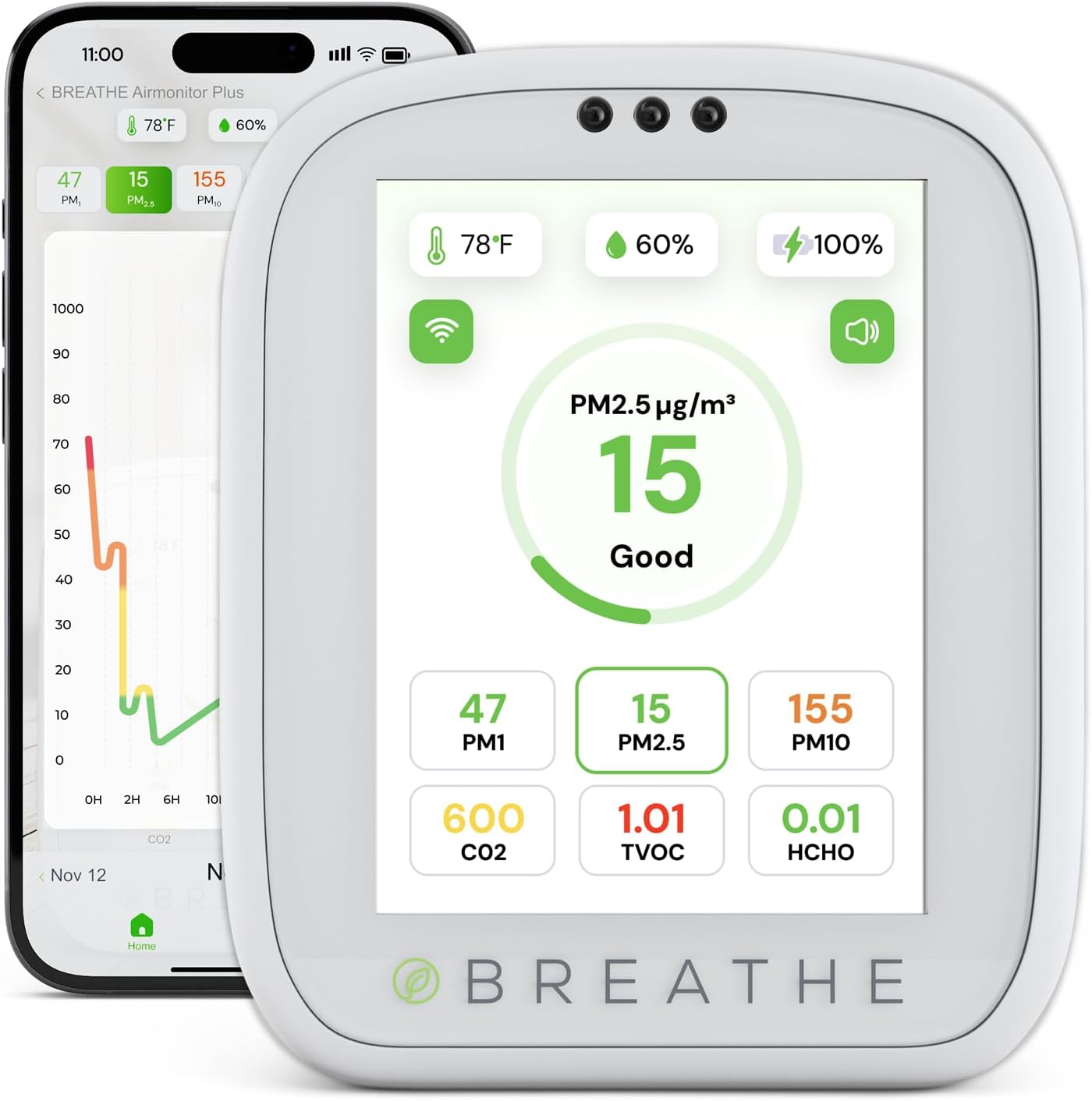
BREATHE Airmonitor Plus CO2 NDIR PM TVOC
The BREATHE Airmonitor Plus is an indoor air quality monitor tracking CO2 via NDIR sensor along with PM1 PM2.5 PM10 TVOC HCHO temperature and humidity. Its standout quality is the multi-sensor accuracy paired with app-based alerts and data export making it suitable for homes offices and allergy-sensitive users.
Pros
- Combines CO2 NDIR with particle and gas sensors for comprehensive insight
- Fast WiFi setup and customizable alerts via the free app
- Clear graphs and CSV export support data-driven decisions
- Modern design suits visible placement in living or work areas
Cons
- Battery supports only short portable sessions before needing a wall connection
- Full history and remote access require consistent 2.4 GHz WiFi
- Requires occasional manual calibration for peak sensor performance
Airthings 2960 View Plus 7-Sensor Monitor
Battery-powered radon and air quality tracking in one Wi-Fi unit, this monitor measures seven parameters and stores trends in the cloud. It fits households that want continuous radon awareness alongside PM2.5, CO2, VOC, humidity, temperature, and pressure readings. Because setup requires an account and app, it works best for users who want remote alerts and multi-room coverage rather than a standalone display.
Pros
- Measures radon, PM2.5, CO2, VOC, humidity, temperature, and air pressure with always-on sensors.
- Uses passive diffusion chamber sampling with alpha spectrometry for radon detection.
- Connects to other Airthings monitors for multi-room coverage and works with Alexa or Homey.
- Free app provides live readings, trend history, notifications, and pollen forecast data.
- Optional free registration within 30 days can extend the warranty to five years.
Cons
- Full use requires the Airthings app, an account, and internet access.
- Average battery life is about two years, so users need to maintain the power source over time.
- On-device alarm is visual only.
How We Picked
To build this list of 5 monitors, we compared detailed specifications, manufacturer data, and aggregated user feedback to identify models that excel in key areas for 2026. Our goal was to provide an objective, transparent selection based on the following criteria critical for effective indoor air monitoring:
- Sensor Range & Accuracy: Prioritizing devices capable of detecting both VOCs and radon with reliable, precise sensors.
- Data Accessibility & Display: Evaluating the clarity of real-time data, whether on-device or via a companion app.
- Connectivity & Smart Features: Considering WiFi, Bluetooth, and smart home integration for alerts and automation.
- Ease of Use & Design: Assessing setup complexity, power options (battery vs. plug-in), and form factor for placement.
- Value & Longevity: Balancing feature sets against price and considering warranty length.
Buying Guide: Making Sense of Best Voc And Radon Indoor Air Quality Monitors
Identify Your Primary Pollutants
Not all monitors track the same things. If radon is your main concern, you need a dedicated sensor, as found in the Airthings 2960 View. For general indoor air quality, focus on combined VOC, PM2.5, and CO2 detection. Tip: Check your local radon risk zone to determine if this specialized sensor is a necessary investment.
Consider Your Data Preferences
Do you want instant, at-a-glance readings or deep historical analysis? Devices with large built-in displays, like the 16 in 1 Air Quality Monitor Indoor 7″ Wildfire CO2, are great for quick checks. Models that sync to a smartphone app, such as the BREATHE Airmonitor Plus Indoor Air Quality Monitor, offer trend tracking and remote notifications.
Evaluate Placement and Power
Think about where the monitor will live. Battery-powered units offer cable-free placement anywhere, ideal for basements where radon levels are often highest. Plug-in models are better for permanent spots like a living room shelf. Ensure the device’s design fits your intended space aesthetically and functionally.
Quick Checklist
- Does it specifically detect both VOCs and radon if needed?
- Is the display type (on-device vs. app) suitable for your daily use?
- Does it connect to your existing smart home system?
- What is the sensor calibration process and warranty period?
- Is the form factor and power source right for your chosen location?
Related reading: For more on tech that enhances your home environment, see our guide on The 5 Best Voc And Radon Indoor Air Quality Monitors of 2026.
FAQs
What is the best voc and radon indoor air quality monitors in 2026?
The best model depends on your needs. For most users seeking a comprehensive overview with a large display, the 16 in 1 Air Quality Monitor Indoor 7″ Wildfire CO2 is a top contender. For dedicated radon monitoring, a specialized device like the Airthings 2960 View is essential.
How accurate are these home air quality monitors?
Consumer-grade monitors provide reliable trend data and alerts, sufficient for home use. They use advanced sensors, like the NDIR sensor in the BREATHE Airmonitor Plus, for good accuracy. For certified lab-grade precision, you would need professional equipment.
Where should I place my air quality monitor?
Place it in the area you occupy most, like a living room or bedroom, at breathing height. Avoid direct airflow from vents, windows, or kitchens to prevent skewed readings. For radon, the basement or lowest livable level is often recommended.
Do I need WiFi or app connectivity?
Connectivity is crucial for remote alerts and historical data analysis. If you want to check air quality while away or receive smartphone notifications about poor air, choose a WiFi-enabled model. For simple, local-only reading, a standalone device suffices.
How often do sensors need maintenance or replacement?
Most sensors are designed to last for years. Some may require occasional recalibration, as guided by the app. Keep sensors free of dust and avoid exposing them to direct contaminants like perfume or smoke to maintain accuracy.
Can these monitors help improve my air quality?
Absolutely. By identifying pollutant sources (like cooking, cleaning, or poor ventilation), you can take action, increasing ventilation, using an air purifier, or addressing a radon issue. The Temtop M10+ 6-in-1 CO2 Meter & Indoor Air Quality, for example, helps you understand when to open a window. For deeper dives into data-driven solutions, check our AI & Software section.
Final Thoughts
Selecting the right monitor means matching its strengths to your specific concerns. The 16 in 1 Air Quality Monitor Indoor 7″ Wildfire CO2 is best for those who want a comprehensive, all-in-one view of their air on a large screen. The Airthings 2960 View Plus is the clear choice for anyone needing professional-grade, continuous radon detection alongside other metrics. For users deeply embedded in the Alexa ecosystem who value smart home automation, the Amazon Smart Air Quality Monitor seamlessly integrates alerts and actions. Once your monitor arrives, place it in an optimal location away from direct drafts, follow the setup instructions carefully, and allow it to run for a few days to establish a baseline for your indoor environment.
About the author
Daniel covers mini PCs, laptops and monitors. His guides compare processors, graphics, ports, cooling and upgrade options across models, and explain which specifications actually matter for gaming, office work and home labs.