Asustor AS6810T Review: Enterprise NAS with Dual 10GbE & USB4
The Asustor Lockerstor 10 Gen3 AS6810T is a high-performance 10-bay NAS built for demanding storage, virtualization, and media workflows, offering enterprise-grade stability and exceptional connectivity.
 By Elvis Dicki
Updated October 22, 2026
In the realm of high-capacity, high-performance network-attached storage, the Asustor AS6810T presents itself as a formidable solution designed to move beyond basic home server duties. This 10-bay NAS enclosure is engineered for IT professionals, creative studios, and power users who require enterprise-grade stability, massive storage scalability, and blistering transfer speeds for tasks like virtualization, 4K/8K media editing, and large-scale backup systems. At its core, it combines an AMD Ryzen Embedded processor with server-grade ECC memory and a wealth of cutting-edge connectivity, including dual 10GbE ports and USB4, positioning it as a central hub for the most data-intensive workflows.

This review analyzes the specifications and features of the Asustor Lockerstor 10 Gen3 AS6810T to determine where it excels and for whom this investment makes the most sense. Given its diskless nature and professional feature set, it is clearly not a plug-and-play consumer device but a powerful tool for building a customized, high-performance storage server. The bottom line is that the AS6810T is built for speed, capacity, and data integrity, making it a compelling choice for environments where network performance and reliability are non-negotiable.
Asustor Lockerstor 10 Gen3 AS6810T 10-Bay NAS AMD





As an Amazon Associate we earn from qualifying purchases. Product prices and availability are accurate as of the date/time indicated.
Asustor AS6810T at a Glance
| Specification | Detail |
|---|---|
| Model | Asustor Lockerstor 10 Gen3 AS6810T |
| Processor | AMD Ryzen Embedded V3C14 Quad-Core |
| Memory | 16GB ECC DDR5 (Expandable to 64GB) |
| Drive Bays | 10 x 3.5″/2.5″ SATA HDD/SSD |
| M.2 NVMe Slots | 4 x PCIe 4.0 (for caching/storage) |
| Network Ports | Dual 10GbE RJ-45, Dual 5GbE RJ-45 |
| USB Ports | 2 x USB4 (40Gbps), 2 x USB 3.2 Gen2 |
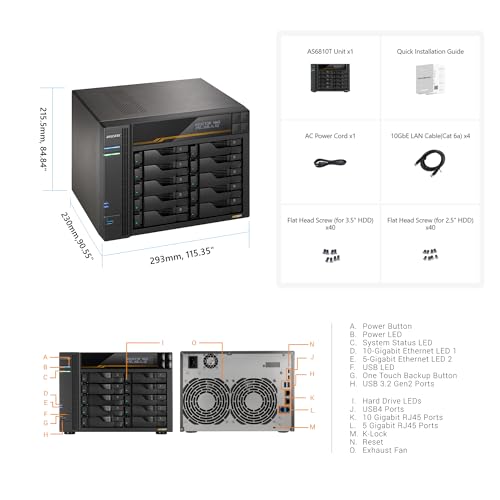
| Dimensions | 15.75 x 14.57 x 13.78 inches |
| Key Feature | Enterprise-grade stability with ECC RAM |
Design and Build
The Asustor AS6810T adopts a functional, server-oriented design centered on accessibility and cooling. Its black chassis, measuring 15.75 by 14.57 by 13.78 inches, is built to house ten drive bays, which are likely tool-less for easier installation of HDDs or SSDs. The front panel typically provides status indicators and USB ports for quick access. A key design focus is thermal management, with dedicated cooling vents mentioned for the four internal M.2 NVMe SSD slots to ensure they run at optimum performance. The build quality is geared towards 24/7 operation, reflecting its enterprise and enthusiast target audience. The overall aesthetic is professional and understated, prioritizing utility and rack-mount compatibility over consumer flair, fitting seamlessly into a server closet or professional studio environment.
Performance and Features
Processing Power and Memory
The heart of the AS6810T is an AMD Ryzen Embedded V3C14 quad-core processor, a chip designed explicitly for enterprise workloads like virtualization and continuous operation. This provides a solid foundation for running multiple services, containers, or virtual machines directly on the NAS. Paired with this CPU is 16GB of ECC (Error-Correcting Code) DDR5 memory, expandable to 64GB. ECC memory is a critical feature for mission-critical storage, as it detects and corrects common types of data corruption in real-time, preventing crashes and data loss—a level of stability expected in servers but less common in consumer NAS units.
Storage and Acceleration
Storage flexibility is a major strength. The ten drive bays support massive capacities for bulk storage, backups, and media libraries. The standout feature is the four dedicated M.2 NVMe slots that utilize the PCIe 4.0 interface. These slots can be configured for all-flash storage volumes or, more commonly, as a high-speed cache. Using SSDs here dramatically accelerates random I/O performance, which benefits databases, multi-user environments, and creative applications like video editing where accessing many small files quickly is essential.
Connectivity: A Speed Demon’s Dream
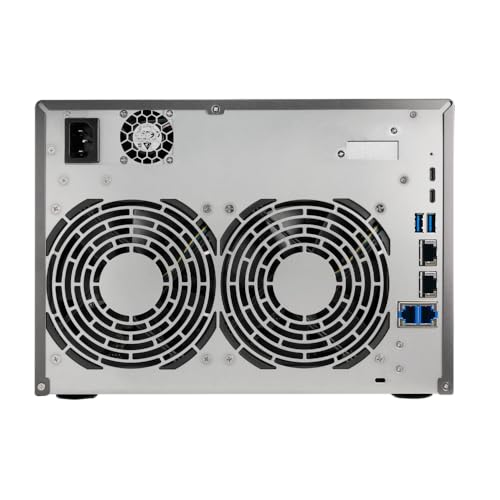
This is where the AS6810T truly separates itself. The networking suite is exceptional, featuring dual 10-gigabit Ethernet (10GbE) and dual 5-gigabit Ethernet (5GbE) ports. This allows for ultra-high bandwidth for multiple users, link aggregation for redundancy and increased throughput, and segmentation of network traffic. For external expansion, it includes two USB4 ports offering speeds up to 40Gbps, compatible with Thunderbolt 3/4 devices for ultra-fast backups or direct connection to another compatible Asustor NAS for network-free data transfers. Two USB 3.2 Gen2 ports provide additional high-speed peripheral connectivity.
Software and Security Features
The NAS runs Asustor’s ADM operating system, which provides a wide range of applications for backup, media serving, surveillance, and more. Key software features highlighted include WORM (Write Once, Read Many) immutable storage to protect against ransomware by making data unchangeable for a set period, and built-in antivirus tools. The AiMaster mobile app allows for remote setup, management, and power control. The system also supports cross-platform file sharing (SMB, AFP, NFS) and features like MyArchive, which allows individual drives to be used as removable, offline backup archives.
Setup, Support and Ownership
Potential owners must note that the AS6810T ships diskless, requiring a separate investment in hard drives and potentially NVMe SSDs. Initial setup is facilitated by the AiMaster mobile app, which guides users through finding the NAS on the network and installing the ADM operating system. Upgrades are a key part of ownership; the ECC DDR5 RAM can be expanded to 64GB, and all drive bays and M.2 slots are user-accessible. Asustor provides firmware updates for the ADM OS and applications. The enterprise focus suggests a level of support geared towards professional users, though specific warranty terms are not detailed in the provided data. Users should anticipate higher power consumption due to the powerful processor, numerous drives, and high-speed ports, which is typical for a device in this class.
What Owners Say
Based on the aggregated rating, the Asustor AS6810T has been received positively by owners, earning a high average score. This suggests that users find it delivers on its promises of performance, stability, and features. While specific review excerpts are not available, the high rating implies satisfaction with its core competencies: fast transfer speeds facilitated by the 10GbE and M.2 slots, reliable operation thanks to the ECC memory, and the flexibility offered by the numerous bays and ports. As with any complex device, some users may note a learning curve associated with its advanced features.
Pros and Cons
Pros
- Exceptional connectivity with dual 10GbE and USB4 ports
- Enterprise-grade stability from ECC DDR5 memory
- High storage potential with 10 bays plus 4 M.2 NVMe slots
- Powerful AMD Ryzen processor for virtualization and heavy workloads
- Robust security features including WORM immutable storage
- Flexible expansion via MyArchive and upgradable RAM
Cons
- Requires separate purchase of all storage drives
- Advanced features like USB4 direct NAS linking have limited compatibility
- Higher power consumption is expected
- Professional focus may mean a steeper learning curve for novices
- Substantial physical footprint
- Premium price point for the enclosure alone
Who Should Buy It (and Who Should Skip It)
The Asustor AS6810T is an ideal fit for IT professionals managing business storage, backup, or virtualization servers. Creative studios working with 4K/8K video who need a fast, shared storage target for editing workflows will also find it highly capable. Enthusiasts with homelabs running complex Docker containers, AI inference servers (like RAG), or needing a high-performance backbone for their network will appreciate its power and expandability. It’s perfect for those who prioritize data integrity (ECC memory) and need the bandwidth of 10GbE networking.
This NAS is not recommended for casual users or those looking for simple, out-of-the-box network storage for basic photo backups and media streaming. The cost of the enclosure plus the required drives represents a significant investment. Individuals without a 10GbE network infrastructure at home will not fully utilize its flagship feature. Those seeking a quiet, low-power device for a living space should look at smaller, consumer-oriented models, as explored in our guide to the best tech gear for streamlined setups.
Final Verdict
The Asustor Lockerstor 10 Gen3 AS6810T is a specification powerhouse that delivers a server-grade feature set in a NAS enclosure. Its combination of a robust AMD Ryzen CPU, ECC memory, unparalleled connectivity options, and massive storage potential makes it one of the most capable devices in its category. It successfully bridges the gap between high-end enthusiast gear and true enterprise hardware, offering features like WORM storage and quad M.2 caching that are crucial for professional and security-conscious environments.
While the requirement to purchase drives separately and its inherent complexity mean it’s not for everyone, for its target audience—IT administrators, video professionals, and serious homelab enthusiasts—it represents a highly compelling and future-proof solution. If your work depends on fast, reliable, and scalable network storage, the AS6810T’s performance and features justify serious consideration, much like how selecting the right foundational tools is critical in fields from cybersecurity to content creation.
FAQs
Does the Asustor AS6810T come with hard drives installed?
No, the AS6810T is sold as a diskless enclosure. You must purchase and install your own 3.5-inch or 2.5-inch SATA hard drives or SSDs for the ten main bays, and optionally, M.2 NVMe SSDs for the four acceleration/cache slots. This allows users to select drives based on their specific needs for capacity, speed, and budget.
What is the benefit of ECC DDR5 memory in a NAS?
ECC (Error-Correcting Code) memory detects and corrects the most common kinds of data corruption that can occur in RAM. In a NAS, this prevents corrupted data from being written to your storage drives, enhancing system stability and data integrity. It is a critical feature for 24/7 operation, business-critical data, and virtualization workloads, making the NAS more reliable over long periods.
Can I use the USB4 port to connect a Thunderbolt drive from my Mac?
Yes, the USB4 ports on the AS6810T are listed as compatible with Thunderbolt 3 and 4 devices. This means you can connect Thunderbolt external storage drives from a Mac or PC directly to the NAS for extremely fast data transfers, backups, or expansion, leveraging speeds up to 40Gbps.
Is this NAS suitable for running a Plex Media Server or other applications?
Absolutely. The powerful AMD Ryzen quad-core processor and ample, expandable RAM make the AS6810T more than capable of running media servers like Plex, Emby, or Jellyfin, even for multiple concurrent streams and transcoding. Its strength lies in also being able to handle far more demanding applications simultaneously, such as hosting virtual machines, database servers, or Docker containers, as discussed in our AI & Software resources. The M.2 SSD caching can significantly improve the responsiveness of application libraries and metadata.
About the author

Elvis Dicki writes reviews and buying guides for CyberSecLabs.