QNAP TS-216G-US Review: Connects to 2.5GbE for Home File Storage
The QNAP TS-216G-US is an affordable, diskless 2-bay NAS that brings 2.5GbE connectivity and AI acceleration to home and small office users for centralized storage and media streaming.
 By Elvis Dicki
Updated October 22, 2026
For home users and small offices seeking a reliable, centralized hub for their digital lives, network-attached storage (NAS) offers a compelling solution. The QNAP TS-216G-US enters this space as a diskless, two-bay desktop enclosure designed to be an efficient and affordable file storage center. It targets those who want to consolidate personal or family photos, music, and videos, enjoy easy file access and synchronization across multiple devices, and even run basic productivity tools. In short, this NAS aims to deliver high performance and smart management for everyday data needs without a hefty price tag.

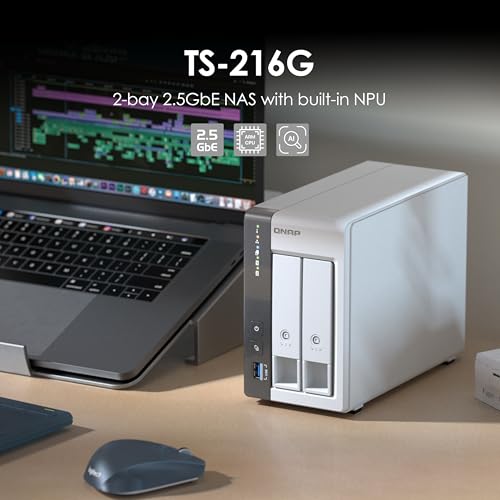
Positioned as “The Most Affordable 2-Bay 2.5GbE Desktop NAS,” the TS-216G-US is equipped with an ARM Cortex-A55 quad-core CPU, a built-in NPU for AI acceleration, and 4GB of DDR4 RAM. This combination suggests a focus on capable multitasking and unique features like face recognition, all while maintaining a budget-friendly profile. This review analyzes its specifications, design, and intended use cases to determine if it lives up to its promise as a capable entry point into faster networked storage. For more expert analysis on tech gear for your setup, explore our related Tech Gear content.
Prime QNAP TS-216G-US 2-Bay 2.5GbE NAS with Quad-Core




As an Amazon Associate we earn from qualifying purchases. Product prices and availability are accurate as of the date/time indicated.
QNAP TS-216G-US at a Glance
| Specification | Detail |
|---|---|
| Model | TS-216G-US |
| Form Factor | Desktop |
| Drive Bays | 2 x 3.5-inch SATA | Processor | ARM Cortex-A55 Quad-Core 2.0 GHz |
| Memory | 4 GB DDR4 (onboard) |
| Network Ports | 1 x 2.5 Gigabit Ethernet, 1 x Gigabit Ethernet |
| Special Features | Built-in NPU for AI Acceleration, One-Touch USB Copy |
| USB Ports | 1 x USB 3.2 Gen 1, 2 x USB 2.0 |
| Primary Use Case | Personal & Multimedia Storage for Home/Small Office |
| Warranty | 2 Years |
Design and Build
The QNAP TS-216G-US adopts a compact desktop form factor, which is typical for two-bay NAS enclosures aimed at home users. Its enclosure material is listed as metal, which should aid in heat dissipation and provide a degree of durability for an always-on device. The unit is offered in a white finish, helping it blend into a modern home or office environment more discreetly than some black counterparts. The front panel logically houses the two drive bays, which support 3.5-inch SATA hard disk drives (HDDs) or likely 2.5-inch SSDs, though the manufacturer specifications explicitly list 3.5-inch SATA 6Gb/s compatibility.
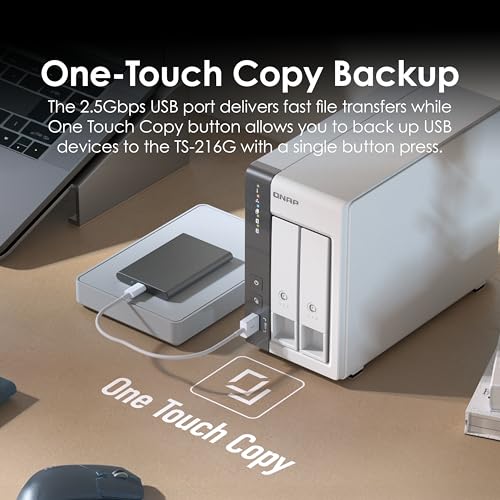
A key physical feature highlighted by QNAP is the “One-Touch-Copy” button. This provides a simple, hardware-based method for users to initiate backups from connected USB devices directly to the NAS storage, streamlining a common task without needing to navigate the software interface. The overall design philosophy appears focused on simplicity and practicality, prioritizing essential functions and ease of use for its target audience over flashy aesthetics or extensive front-panel displays.
Performance and Features
Processing and Memory
At the heart of the TS-216G-US is an ARM Cortex-A55 quad-core processor clocked at 2.0 GHz. This modern ARM architecture is known for balancing performance with low power consumption, making it suitable for a device intended for 24/7 operation in a home setting. It is paired with 4 GB of onboard DDR4 RAM. This configuration is designed to handle multitasking associated with file serving, media streaming, and running the QNAP operating system and its applications. The manufacturer states it enables multitasking with low power consumption, which aligns with the needs of budget-conscious and energy-aware users. However, the RAM is not user-upgradable, as it is soldered onboard, which is a consideration for future needs.
Connectivity and Networking
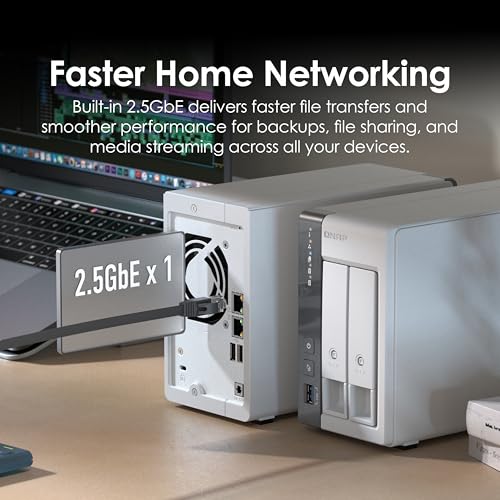
Networking is a standout feature of this model. It includes two Ethernet ports: one standard Gigabit (1GbE) port and one 2.5 Gigabit Ethernet (2.5GbE) port. The inclusion of a 2.5GbE port at this price point is a significant differentiator, as it allows for theoretical data transfer rates two and a half times faster than traditional Gigabit Ethernet when connected to compatible network switches and client devices. This accelerates file sharing across teams and devices and can streamline transfers of large files like video projects or extensive photo libraries. For users with a growing collection of high-resolution media, this can reduce wait times for backups and access.
For peripheral expansion, the NAS provides three USB ports: one faster USB 3.2 Gen 1 port and two USB 2.0 ports. These can be used for connecting external hard drives, printers, or uninterruptible power supplies (UPS). The USB 3.2 Gen 1 port, in particular, works with the front-panel button to facilitate the “Quick USB One-Touch Copy” feature for fast backups from external storage.
AI Acceleration and Software Features
A unique hardware feature for a NAS in this class is the built-in Neural Processing Unit (NPU). This dedicated processor is designed to accelerate AI-specific tasks within QNAP’s software ecosystem, primarily through their “AI Core” application. The practical benefit cited is boosting performance for high-speed face and object recognition in photo libraries. This can automatically organize personal or family photos, saving time on manual sorting. Beyond AI, the QNAP QTS operating system provides a wide array of applications for file synchronization, multimedia streaming, and productivity, allowing users to tailor the device to their workflow. For insights into how AI is integrated into other home devices, our expert picks offer a broader perspective.
Setup, Support and Ownership
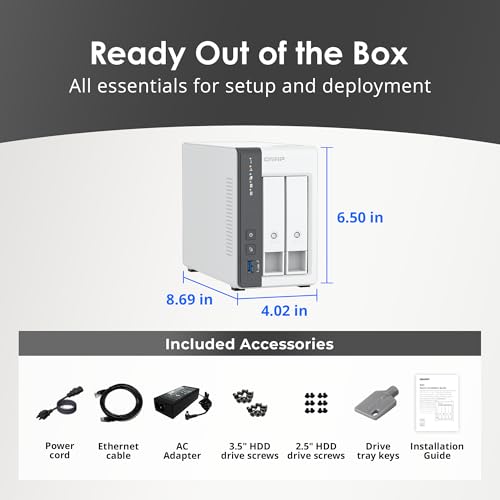
As a diskless model, the primary setup task for the QNAP TS-216G-US involves procuring and installing two compatible 3.5-inch SATA hard drives or SSDs. Users must factor this additional cost and installation step into their purchase. The initial system setup is managed through QNAP’s QTS operating system, which guides users through creating storage volumes, setting up user accounts, and configuring network settings. The presence of the one-touch copy button simplifies one common post-setup task: importing data from existing USB drives.
QNAP provides a 2-year warranty for this product, which is a standard offering for consumer NAS devices. Support is offered through their online resources, including manuals, firmware updates, and a knowledge base. As with any network-connected storage device, maintaining updated firmware is crucial for security and performance, a process managed through the QTS interface. The two-bay design offers straightforward expansion up to the capacity of two drives, typically using RAID 1 (mirroring) for redundancy or RAID 0/JBOD for maximum capacity, but does not allow for expansion beyond adding larger drives in the future, as there are no additional bays or expansion ports listed for this model.
What Owners Say
While detailed buyer review excerpts are not available in the provided data, the aggregated customer rating is notably high. The product holds a strong rating, with the rating distribution showing perfect scores from the available feedback. This suggests a high level of satisfaction among early adopters who have purchased and used the device. Such feedback typically correlates with the product meeting or exceeding expectations for its intended use case, particularly regarding ease of use, value for money, and reliable performance for home and small office tasks. For more user-focused evaluations on different products, browse our Reviews category.
Pros and Cons
Pros
- Strong value for entry-level 2.5GbE network performance.
- Built-in NPU enables practical AI photo organization tools.
- Low power consumption supports always-on home operation.
- Easy USB integration with a dedicated one-touch copy button.
- Compact desktop form factor fits easily into most spaces.
- Provides a centralized hub for media streaming and file access.
Cons
- Sold diskless, requiring separate purchase of hard drives.
- Memory is fixed at 4GB and not user-upgradable.
- Only two drive bays limit maximum storage capacity and RAID options.
- May not be suited for heavier, multi-user business applications.
- The full potential of 2.5GbE requires a compatible network infrastructure.
- Performance for intensive applications may be constrained by the ARM processor compared to x86 alternatives.
Who Should Buy It (and Who Should Skip It)
The QNAP TS-216G-US is ideally suited for home users, families, or small office workers who need a simple, affordable, and efficient centralized storage solution. It’s a perfect fit for someone looking to consolidate photos, music, and videos from multiple devices, set up a personal cloud for remote access, or create a reliable backup destination for PCs and laptops. The 2.5GbE port is a forward-looking bonus for users with fast home networks or those who frequently transfer large files. The AI-powered photo management is a compelling feature for anyone with a large, unorganized digital photo library.
This NAS should be skipped by users who require more than two drives for massive storage capacity or advanced RAID configurations like RAID 5 or 6. It is also not the best choice for environments needing to run numerous demanding virtual machines, databases, or heavy-duty server applications, as the ARM processor and fixed 4GB RAM have their limits. Businesses with more than a handful of concurrent users or complex IT needs should consider more powerful, scalable models. Additionally, anyone unwilling to purchase and install their own hard drives should look for a pre-configured bundle.
Final Verdict
The QNAP TS-216G-US successfully carves out a niche as an accessible entry point into modern NAS features. Its combination of a 2.5GbE network port, a dedicated AI accelerator (NPU), and a capable quad-core ARM processor in a compact, two-bay design is impressive for the price segment. It delivers on the core promises of easy file sharing, multimedia streaming, and centralized storage for a home or small office, with the added bonus of faster network speeds and intelligent photo management. The build quality and included warranty provide assurance for long-term reliability.
While its diskless nature and two-bay limit are inherent constraints of the form factor, they are reasonable trade-offs for the target audience seeking an affordable and efficient storage hub. For those whose needs align with its strengths—consolidating media, safeguarding data, and leveraging faster network transfers—the TS-216G-US represents a compelling and feature-rich option that punches above its weight class. It demonstrates that advanced features like 2.5GbE and AI acceleration are becoming accessible at the consumer level.
FAQs
Does the QNAP TS-216G-US come with hard drives?
No, the QNAP TS-216G-US is sold as a diskless enclosure. This means you must purchase and install your own 3.5-inch SATA hard disk drives or solid-state drives separately. The device has two bays to accommodate these drives, allowing you to choose the capacity and type (HDD or SSD) that best fits your budget and performance needs.
What is the NPU used for?
The NPU, or Neural Processing Unit, is a dedicated processor for accelerating artificial intelligence tasks. In the TS-216G-US, it works with QNAP’s AI Core software to perform high-speed face and object recognition on your photo library. This can automatically sort and tag photos, making it much easier to find specific pictures of people or items without manual organization.
Do I need a special router to use the 2.5GbE port?
To fully utilize the 2.5 Gigabit per second speed of the port, you need a network switch, router, or a direct connection to a computer that also supports 2.5GbE (or higher) networking. If your existing network equipment only has standard Gigabit (1GbE) ports, the NAS will still work perfectly but will operate at the lower 1GbE speed on that connection. The device also includes a standard 1GbE port for compatibility.
Can I use the QNAP TS-216G-US for video surveillance?
QNAP NAS devices often support surveillance station software, which allows them to record footage from IP cameras. While the manufacturer’s description for the TS-216G-US focuses on personal multimedia and file storage, the presence of the NPU could potentially benefit video analytics. You would need to verify specific camera channel limits and software compatibility through QNAP’s official resources for this model, as this detail is not listed in the provided specifications.
About the author

Elvis Dicki writes reviews and buying guides for CyberSecLabs.