Amazon Renewed Archer AX1450 Review: Wi-Fi 6 Budget Upgrade with Renewed Caveats
The Amazon Renewed TP-Link Archer AX1450 delivers core Wi-Fi 6 benefits like OFDMA and beamforming at a budget price, but its renewed status and limited 2.4 GHz speed are key considerations.
 By Elvis Dicki
Updated October 22, 2026
For those looking to modernize their home network without a significant investment, renewed networking gear presents a compelling opportunity. The Amazon Renewed Archer AX1450 is a Wi-Fi 6 dual-band router that aims to bring next-generation features like OFDMA and beamforming to small and medium-sized homes at an accessible price point. This review analyzes its specifications, features, and owner feedback to determine if this renewed unit is the right budget-conscious step into Wi-Fi 6.

At its core, the Archer AX1450 is designed to handle the increasing number of connected devices in modern households by leveraging Wi-Fi 6 efficiency. It promises up to 1.45 Gbps of combined dual-band speed, stronger focused coverage through its four antennas, and simplified management via a mobile app. For users seeking to replace an older router or upgrade from an internet service provider’s basic equipment, this model offers a feature set that targets common pain points like network congestion and spotty coverage. The bottom line: this renewed router provides a cost-effective entry into Wi-Fi 6, but its performance ceiling and condition are shaped by its renewed nature.
Prime TP-Link Archer AX1450 WiFi 6 Dual-Band Router
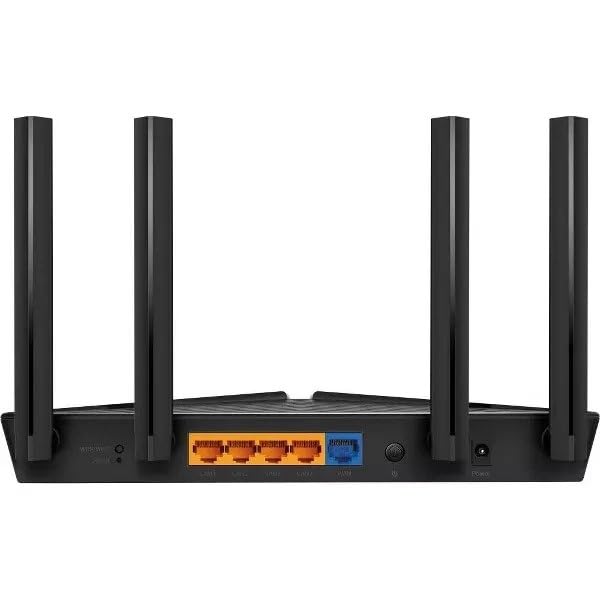
As an Amazon Associate we earn from qualifying purchases. Product prices and availability are accurate as of the date/time indicated.
Amazon Renewed Archer AX1450 at a Glance
| Specification | Detail |
|---|---|
| Wi-Fi Generation | Wi-Fi 6 (802.11ax) |
| Frequency Bands | Dual-Band (2.4 GHz & 5 GHz) |
| Maximum Speed | Up to 1.45 Gbps (1201 Mbps on 5 GHz, 250 Mbps on 2.4 GHz) |
| Key Technologies | OFDMA, Beamforming, Target Wake Time |
| Antennas | 4 External Antennas |
| Ethernet Ports | 1 Gigabit WAN Port, 4 Gigabit LAN Ports |
| Security Protocols | WPA2, WPA3 |
| Management | TP-Link Tether App |
| Recommended Use | Home, Small Office |
| Warranty | 90-Day Limited Warranty |
Design and Build
The TP-Link Archer AX1450 follows a conventional router design with four non-removable external antennas positioned to provide extensive wireless coverage. Its physical build is centered on functionality for home or small office environments. As a renewed product, the unit has been inspected and tested to work like new, but the manufacturer notes it may show light signs of prior use. The renewed process includes a generic accessory set and is backed by a 90-day limited warranty, which is a shorter coverage period than typical for new routers. The design prioritizes practical wireless performance with beamforming technology that focuses signal strength toward connected devices, rather than aesthetic flourishes.
Performance and Features
Wireless Performance and Speeds
The Archer AX1450’s headline feature is its Wi-Fi 6 (802.11ax) compatibility, which forms the basis for its performance claims. It operates on dual bands, with a maximum theoretical speed of 1.45 Gbps. This is split between a 5 GHz band capable of up to 1201 Mbps and a 2.4 GHz band capped at 250 Mbps. The 2.4 GHz speed is sufficient for basic browsing and IoT devices but represents a limitation for bandwidth-intensive tasks on that band. The router’s hybrid network type and use of technologies like OFDMA (Orthogonal Frequency Division Multiple Access) are designed to improve efficiency when multiple devices are connected simultaneously, reducing lag by communicating data to more devices at once.
Connectivity and Ports
Wired connectivity is provided through Ethernet ports. The router includes one Gigabit WAN port for connecting to your modem and four Gigabit LAN ports for wired devices like desktop computers, gaming consoles, or network-attached storage. The LAN port bandwidth is listed at 1000 Mbps, aligning with the Gigabit standard. This wired backbone supports the maximum upstream data transfer rate specified. The router maintains backward compatibility with all previous 802.11 Wi-Fi standards, ensuring it works with older smartphones, laptops, and smart home devices.
Key Technologies and Software
Beyond raw speed, the Archer AX1450 incorporates several Wi-Fi 6 technologies aimed at improving the user experience. Beamforming technology works with the four antennas to direct wireless signals toward connected devices for more reliable coverage. Target Wake Time (TWT) is a power-saving feature that schedules check-in times for devices, potentially extending the battery life of smartphones and laptops. For management, TP-Link provides the Tether app, which is listed as the operating system for setup and control. Security is handled by WPA2 and the newer WPA3 protocol, offering improved protection for the wireless network.
Setup, Support and Ownership
Setup is designed to be conducted through the TP-Link Tether mobile app, promising a process that takes minutes. However, owner experiences with setup vary, with some finding it straightforward and others requiring online resources for guidance. The product data does not specify if physical setup guides are included with renewed units, and one review excerpt mentioned the lack of a manual. Support and long-term ownership rely on TP-Link’s firmware updates, though the update policy or schedule is not detailed in the provided specifications. The 90-day limited warranty is a key ownership consideration, offering a shorter safety net compared to the standard one-year warranty often found on new networking equipment. For those in larger or multi-story homes, this router may struggle to provide comprehensive coverage, potentially necessitating a mesh system or more powerful router, as explored in our guide to the best routers for large homes.
What Owners Say
Owner feedback for the renewed Archer AX1450 is generally positive, reflected in its 4.1 out of 5-star rating. The distribution shows a majority of five-star reviews, with a smaller portion of one-star experiences. Positive reviews frequently highlight the router’s performance as a significant upgrade over older equipment or provider-supplied gateways, citing faster connection speeds and reliable operation once configured. Several owners praised the value it offers. Critical feedback often centers on the setup process, with some users encountering difficulties using the Tether app and needing to seek help online. There are isolated reports of units that could not be set up, leading to frustration. Comments on range indicate it is satisfactory but not exceptional, which aligns with its positioning for small to medium homes. The renewed condition itself is occasionally noted, but most functional reports indicate the router works as intended.
Pros and Cons
Pros
- Affordable access to Wi-Fi 6 technology
- Efficient handling of multiple devices with OFDMA
- Strong, focused coverage for typical home layouts via beamforming
- Potential for extended client battery life with Target Wake Time
- Simple, app-driven installation for many users
- Backward compatible with all older Wi-Fi devices
Cons
- Renewed unit may show light signs of prior use
- Lower 250 Mbps speed limit on the 2.4 GHz band
- Limited 90-day warranty period
- Setup can be challenging without online resources for some
- May not provide sufficient coverage for very large or multi-story homes
- Performance may be constrained for users with gigabit internet connections
Who Should Buy It (and Who Should Skip It)
The Amazon Renewed Archer AX1450 is an ideal fit for budget-conscious users in small to medium-sized homes or apartments who want to upgrade from an older Wi-Fi 4 or Wi-Fi 5 router. It’s particularly suitable for households with a growing number of connected devices that would benefit from Wi-Fi 6’s OFDMA efficiency to reduce lag. If you’re replacing an internet service provider’s basic combo unit and seek better performance and control, this router offers a compelling step up. It also serves as a practical entry point for those curious about Wi-Fi 6 benefits without a major financial commitment.
This router is not the best choice for users with very high-speed internet plans, particularly gigabit service, as its wireless speeds may not fully saturate such a connection; consider options from our list of the best routers for gigabit internet. Those living in large, sprawling, or multi-story homes should likely skip it in favor of a mesh system or more powerful router with greater coverage. Users who require extensive wired connections beyond four devices may find the port count limiting. If having a brand-new product with a full manufacturer’s warranty is a priority, or if you are uncomfortable with the potential variability of a renewed product’s physical condition, you should consider a new unit instead. For users with many legacy devices that heavily rely on the 2.4 GHz band for high-bandwidth tasks, the 250 Mbps limit on that band could be a constraint.
Final Verdict
The Amazon Renewed TP-Link Archer AX1450 successfully fulfills its role as a budget gateway into modern Wi-Fi 6 networking. It packages meaningful next-generation features—particularly OFDMA for multi-device homes and beamforming for more reliable coverage—into a familiar and functional design. For its target audience, the performance uplift over older hardware can be significant, making everyday browsing, streaming, and connecting smoother. The value proposition is clear, but it comes with the understood compromises of the renewed category, including a shorter warranty and the possibility of cosmetic wear.
When weighing this router, your decision hinges on balancing cost against performance ceilings and condition. Its limitations in raw speed, especially on the 2.4 GHz band, and coverage range define its ideal use case. It is a solid solution for upgrading a basic home network affordably, but power users or those with demanding spatial needs should look elsewhere. Like any renewed tech purchase, it represents a calculated risk for potential savings, and in this case, for many owners, that calculation has paid off with reliable Wi-Fi 6 performance. For alternative compact networking solutions, you might explore our reviews of fanless mini PCs that can serve specialized roles in a home setup.
FAQs
What does “Renewed” mean for this router?
“Renewed” indicates this TP-Link Archer AX1450 is a pre-owned product that has been inspected, tested, and cleaned to work like new by Amazon or a supplier. The product data states it may show light signs of prior use. It comes with a generic accessory set and is backed by a 90-day limited warranty, which is shorter than the typical warranty for a new router.
Is the Archer AX1450 good for gaming?
The Archer AX1450 includes Wi-Fi 6 features like OFDMA that can reduce lag when multiple devices are active, which is beneficial for gaming in a busy household. Its 5 GHz band supports speeds up to 1201 Mbps, which is sufficient for most online gaming. However, for competitive gaming where the lowest possible latency is critical, a direct wired Ethernet connection to one of its Gigabit LAN ports is always recommended over any wireless connection.
How many devices can this router handle?
While the manufacturer does not specify a maximum device count, the router is designed for home and small office use. Its key Wi-Fi 6 technology, OFDMA, is specifically engineered to improve efficiency when communicating with multiple devices simultaneously, reducing congestion. This makes it more capable than previous-generation routers in households with numerous smartphones, tablets, laptops, and smart home gadgets. For insights on routers optimized for dense device environments, see our roundup of the best routers for multiple devices.
What is the main drawback of the 2.4 GHz band on this router?
The primary limitation of the 2.4 GHz band on the Archer AX1450 is its maximum speed of 250 Mbps. While this is adequate for many IoT devices, basic web browsing, and tasks where range is more important than speed, it can be a bottleneck for bandwidth-intensive activities on that band, such as transferring large files over Wi-Fi from an older device that only supports 2.4 GHz. The 5 GHz band offers significantly higher speeds for compatible devices.
About the author

Elvis Dicki writes reviews and buying guides for CyberSecLabs.