GMKtec M7 Ultra Review: A Mini PC for Home Labs and Multi-Display Work
The GMKtec M7 Ultra delivers versatile Ryzen 7 PRO performance in a compact form factor, excelling in multi-display setups and networking tasks while offering solid upgrade potential.
 By Elvis Dicki
Updated October 22, 2026
The GMKtec M7 Ultra is a mini desktop computer that leverages AMD’s Ryzen 7 PRO 6850U mobile processor to deliver desktop-class performance in a chassis barely larger than a game pad. It’s designed for users who need a compact, versatile computing solution that can drive multiple high-resolution displays, handle light gaming, and serve as a capable node for networking projects or a home server. With its extensive connectivity, including dual 2.5GbE LAN and an OCuLink port, and a flexible internal design for upgrades, this mini PC carves out a niche for power users in a small package.

This review analyzes the specifications, design, and real-world feedback for the GMKtec M7 Ultra to determine if its blend of an 8-core/16-thread CPU, integrated Radeon 680M graphics, and prosumer-focused I/O makes it a compelling choice over traditional desktops or other mini PCs. The bottom line is that it’s a highly capable and expandable system for specific multi-tasking and connectivity-heavy use cases, though its integrated graphics have inherent limits for high-end gaming.
GMKtec M7 Ultra Mini PC Ryzen 7 PRO 6850U 16GB


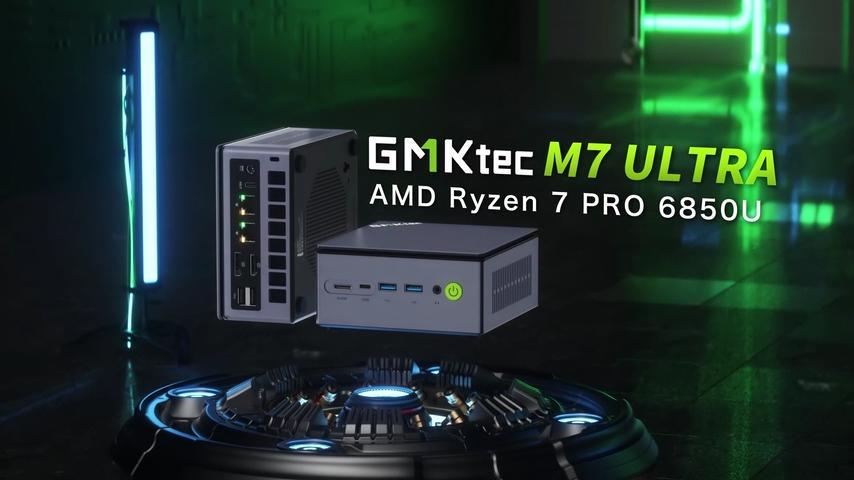
As an Amazon Associate we earn from qualifying purchases. Product prices and availability are accurate as of the date/time indicated.
GMKtec M7 Ultra at a Glance
| Specification | Detail |
|---|---|
| Processor | AMD Ryzen 7 PRO 6850U (8 cores, 16 threads, up to 4.7GHz) |
| Graphics | AMD Radeon 680M (12 cores, integrated) |
| Memory (Pre-installed) | 16GB DDR5 4800MHz (Dual Channel, 2x8GB) |
| Storage (Pre-installed) | 512GB M.2 PCIe 3.0 NVMe SSD |
| Video Output & Display Support | Quad Display via HDMI 2.1, DisplayPort, Dual USB4 (8K@60Hz max) |
| Networking | Dual 2.5GbE LAN, Wi-Fi 6E, Bluetooth 5.2 |
| Key Expansion Ports | OCuLink (PCIe x4), Dual USB4, 2x USB 3.2 Gen2, 2x USB 2.0 |
| Memory Expansion | Dual SO-DIMM slots, supports up to 64GB DDR5 |
| Storage Expansion | Dual M.2 2280 PCIe 4.0 slots, supports up to 16TB total |
| Cooling & Power Modes | Hyper Ice Chamber 2.0 dual fans; BIOS-selectable 35W/50W/65W-70W modes |
Design and Build
The GMKtec M7 Ultra adopts a compact, black chassis typical of the mini PC form factor. Its small size is frequently noted in user reviews, with comparisons to a game pad, making it highly portable and easy to tuck away behind a monitor using the included VESA mount. The build quality is described as good, with a top panel that is easy to remove for accessing the internal upgrade slots. The design prioritizes function, with ventilation for the dual-fan cooling system integrated into the chassis. The port layout is comprehensive, grouping video outputs and high-speed USB ports for convenient cable management in a stationary setup.
Performance and Features
CPU and Graphics Performance
At its core, the AMD Ryzen 7 PRO 6850U is an 8-core, 16-thread processor based on the Zen 3+ architecture, with a maximum turbo speed of 4.7GHz. This configuration provides robust multi-core performance for demanding workloads like coding, graphics editing, and multitasking with numerous applications. The integrated AMD Radeon 680M graphics, with 12 compute units, is a standout feature for integrated graphics. Manufacturer data states its performance is close to a discrete NVIDIA GTX 1050 Ti, and it supports AMD’s FSR 3.0 technology. This allows it to handle AAA gaming titles at lowered quality settings and 1080p resolution, as confirmed by user experiences, though ultra settings in the most demanding modern games will be limited.
Connectivity and Ports
The M7 Ultra’s I/O selection is a major selling point. For displays, it supports a simultaneous quad-screen output via its HDMI 2.1 port, DisplayPort, and two USB4 ports, with support for up to 8K@60Hz resolution. For networking, it features dual Intel 2.5 Gigabit Ethernet ports, enabling applications like firewalls, network aggregation, or serving as a file storage server. Wireless connectivity is handled by Wi-Fi 6E and Bluetooth 5.2. Unique to this class is the inclusion of an OCuLink port, which provides a PCIe x4 connection for external GPU enclosures with potentially higher bandwidth and lower latency than Thunderbolt. The port array is rounded out by multiple USB ports, including two USB4 (supporting power delivery, DisplayPort, and data), two USB 3.2 Gen2, and two USB 2.0 ports.
Key Features and Upgradability
Flexibility is central to the M7 Ultra’s design. The system features three user-selectable performance modes in the UEFI/BIOS: Quiet (35W), Balance (50W), and Performance (65W-70W), allowing users to tune for acoustics or maximum power. The updated BIOS also includes options for VRAM allocation, Wake-on-LAN, and auto power-on. Internally, it offers significant upgrade potential. The pre-installed 16GB of DDR5 RAM is in two 8GB modules, and the dual SO-DIMM slots support a maximum of 64GB. For storage, it has two M.2 2280 slots supporting PCIe 4.0, allowing for up to 16TB of total NVMe storage, though the pre-installed drive is a 512GB PCIe 3.0 model.
Setup, Support and Ownership
The GMKtec M7 Ultra ships with the necessary accessories for basic setup: a power adapter, an HDMI cable, a VESA mount with screws, and a user manual. Owners report the physical setup is straightforward. Installing your own operating system or upgrading components requires removing the top panel, a process described as simple. The manufacturer provides a one-year warranty. Specifics regarding driver support, BIOS update frequency, or long-term software support are not detailed in the provided data. The system’s low power draw in its quieter modes is noted as a benefit for 24/7 operation, such as for a Plex server.
What Owners Say
Owner feedback is largely positive, with the product holding a 4.3 out of 5-star rating. The majority of reviews are 5-star, praising its power, versatility, and compact size. Users highlight its capability as a “budget gaming beast” for AAA titles at 1080p, its excellence as a quiet, low-power Plex server, and its competence for office work, programming, and general multitasking. The extensive connectivity, including the dual 2.5GbE ports and USB4, is frequently appreciated. Critical reviews are in the minority, with a primary concern being reliability, citing instances where a unit stopped working after a short period. The base 16GB RAM is also noted by some as a starting point that benefits from an upgrade for more intensive tasks.
Pros and Cons
Pros
- Powerful 8-core/16-thread Ryzen 7 PRO CPU for multitasking
- Radeon 680M graphics offer notable gaming performance for integrated graphics
- Extensive connectivity with dual 2.5GbE LAN, USB4, and a unique OCuLink port
- Supports quad high-resolution displays simultaneously
- Excellent internal upgrade potential for RAM and storage
- Compact, VESA-mountable design saves space
- Flexible BIOS with selectable power/performance modes
Cons
- Integrated graphics limit ultra settings in demanding modern games
- Base 16GB RAM may require upgrading for heavy multitasking or content creation
- Higher performance modes increase fan activity and power draw
- Some user reports question long-term reliability
- Pre-installed SSD is PCIe 3.0, not the supported PCIe 4.0 standard
Who Should Buy It (and Who Should Skip It)
The GMKtec M7 Ultra is an ideal fit for users who need a compact yet powerful computer for specific, connectivity-heavy tasks. It’s excellent for home lab enthusiasts looking to run a firewall, network storage server, or virtual machines, thanks to its dual 2.5GbE ports and capable CPU. It’s also a strong choice for productivity users who utilize multiple monitors, as its quad-display support is a standout feature. Light gamers and those seeking a small-form-factor living room PC for media and casual gaming will also find it compelling. For more insight on gaming-focused mini PCs, see our guide on the best options available.
This mini PC should be skipped by users whose primary need is high-fidelity gaming at maximum settings, as a system with a dedicated graphics card is required. Those who need maximum multi-core performance for sustained workloads like video rendering may also be better served by a desktop with a higher-TDP processor. If absolute silence is critical, a fanless mini PC design would be more suitable, though with a significant performance trade-off.
Final Verdict
The GMKtec M7 Ultra successfully packages prosumer-level features into a remarkably small chassis. Its strength lies not in being the absolute fastest at any one task, but in being remarkably competent at many. The combination of a potent 8-core Ryzen processor, surprisingly capable integrated graphics, dual high-speed networking ports, and exceptional multi-display support creates a uniquely versatile tool. For users building a tech gear setup that values density and connectivity—such as a compact workstation, a home server, or a network appliance—it presents a compelling argument against bulkier traditional desktops.
Potential buyers should approach with the understanding that its integrated graphics, while good, have clear limits, and the value of the system is fully realized through its expandability and specialized ports like OCuLink. Considering its position within the broader mini PCs category, the M7 Ultra stands out for users who need more than basic computing and are willing to leverage its advanced I/O and upgrade paths. For those with matching needs, it is a thoughtfully designed and powerful compact desktop.
FAQs
Can the GMKtec M7 Ultra run modern games?
Yes, based on manufacturer specifications and user reviews, the AMD Radeon 680M graphics can run many modern AAA games. However, to achieve playable frame rates, you will need to lower graphical quality settings and typically run at 1080p resolution. Its performance is stated to be close to an NVIDIA GTX 1050 Ti, and it supports AMD FSR upscaling technology to help improve performance.
What is the OCuLink port used for?
The OCuLink port provides a direct PCIe x4 connection, primarily intended for connecting an external graphics card (eGPU) enclosure. Compared to more common standards like Thunderbolt, OCuLink can offer higher bandwidth and lower latency for the PCIe connection, which can result in better performance and less lag when using an external GPU for gaming or content creation.
How easy is it to upgrade the RAM and storage?
Upgrading is designed to be user-accessible. The top panel of the mini PC can be removed to reveal two SO-DIMM slots for DDR5 memory (supporting up to 64GB) and two M.2 2280 slots for PCIe 4.0 NVMe SSDs (supporting up to 16TB total). The system comes with 16GB of RAM (2x8GB) and a 512GB PCIe 3.0 SSD pre-installed, both of which can be replaced or supplemented.
Is this mini PC good for use as a server?
Its specifications make it well-suited for light server duties. The dual 2.5 Gigabit Ethernet ports allow for network aggregation, firewall functions, or acting as a router. The efficient AMD processor and configurable power modes enable low-power 24/7 operation, which is ideal for tasks like hosting a Plex media server, a file server, or running home automation software, as reflected in positive user reviews for these use cases.
About the author

Elvis Dicki writes reviews and buying guides for CyberSecLabs.