TP-Link Archer AXE300 Review: Dual 10G Ports for Home Lab & Gaming
The TP-Link Archer AXE300 is a quad-band WiFi 6E router designed for large homes and power users needing high-speed connectivity, extensive device support, and advanced security features.
 By Elvis Dicki
Updated October 21, 2026
In the realm of high-performance home networking, the TP-Link Archer AXE300 emerges as a formidable contender. This router is engineered for users who demand more than just basic internet access; it targets households with extensive smart home ecosystems, serious gamers, and professionals managing home labs or requiring high-bandwidth connectivity. With its quad-band architecture, dual 10G ports, and support for over 200 devices, it promises to handle intensive network traffic with ease.

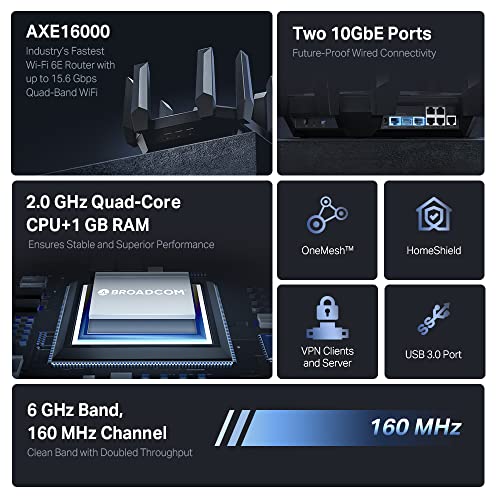
At its core, the Archer AXE300 is built to deliver an unprecedented wireless speed of up to 15.6 Gbps, leveraging the new 6 GHz band for reduced interference and lower latency. Its bottom line is clear: this is a router for those seeking to future-proof their network with top-tier speeds, expansive coverage, and robust security tools, making it a significant investment for the right user.
TP-Link Archer AXE300 AXE16000 Quad-Band WiFi 6E




As an Amazon Associate we earn from qualifying purchases. Product prices and availability are accurate as of the date/time indicated.
TP-Link Archer AXE300 at a Glance
| Specification | Detail |
|---|---|
| Wi-Fi Generation | Wi-Fi 6E (Quad-Band) |
| Max Theoretical Speed | 15.6 Gbps |
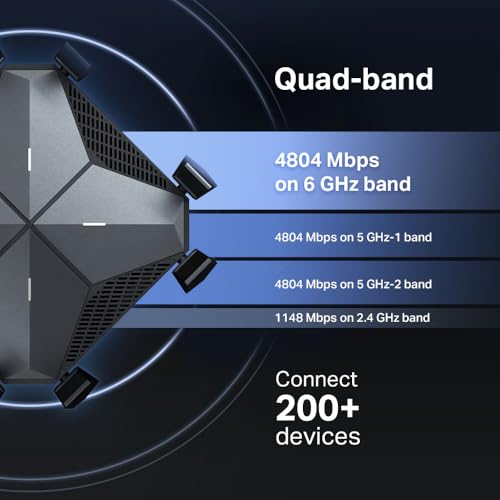
| Bands & Speeds | 6 GHz (4804 Mbps), 5GHz-1 (4804 Mbps), 5GHz-2 (4804 Mbps), 2.4 GHz (1148 Mbps) |
| High-Speed Ports | Dual 10G WAN/LAN (1 RJ45, 1 SFP+/RJ45 Combo), 1x 2.5G WAN/LAN, 4x Gigabit LAN |
| Processor | Powerful Quad-Core CPU |
| Antennas | 8 Retractable Antennas |
| Security | WPA3, VPN Server/Client (OpenVPN/PPTP/L2TP), TP-Link HomeShield |
| Device Support | 200+ Devices |
| Operating System | TP-Link Customized Linux |
| Warranty | 2-Year Manufacturer |
Design and Build
The TP-Link Archer AXE300 carries an award-winning design, having received the iF DESIGN AWARD 2022. It presents a substantial, angular black chassis measuring 9.13 inches in length and width and 2.66 inches in height, weighing 3.4 pounds. The most prominent design features are its eight high-gain, retractable antennas, which are strategically positioned to maximize wireless coverage. This physical footprint suggests it is built for performance and stability rather than discreet placement.
The build quality, as implied by its specifications and award status, is solid. The router’s ports are arranged on the rear, providing a clean and organized connectivity hub. While specific material details are not listed by the manufacturer, the product’s dimensions and weight indicate a robust construction designed to house advanced internal hardware and dissipate heat effectively during high-load operation.
Performance and Features
Wireless Performance and Quad-Band Advantage
The Archer AXE300’s headline feature is its quad-band Wi-Fi 6E capability, delivering a combined theoretical speed of up to 15.6 Gbps. This is split across four dedicated bands: the new 6 GHz band (4804 Mbps), two separate 5 GHz bands (each 4804 Mbps), and a 2.4 GHz band (1148 Mbps). This segmentation is crucial for managing network congestion. The 6 GHz band offers a wide, uncongested channel perfect for high-bandwidth, low-latency tasks like 8K streaming or competitive gaming, while the other bands can handle general devices and legacy connections. The router is designed to support over 200 devices simultaneously, powered by its quad-core processor which handles multiple data streams for browsing, streaming, gaming, and downloading concurrently.
Connectivity and Ports
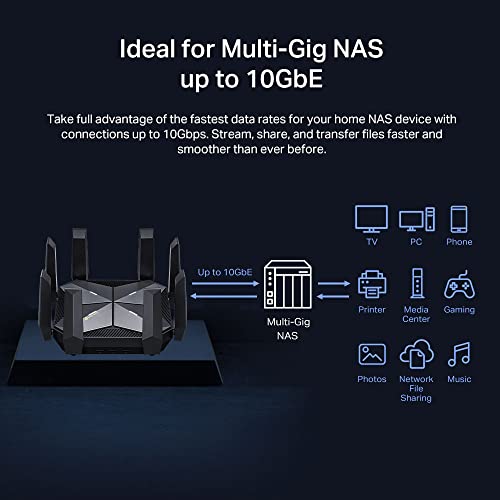
Connectivity is where the Archer AXE300 truly distinguishes itself. It features two 10 Gbps ports: one is a standard RJ45 port and the other is an SFP+/RJ45 combo port. This provides ultra-high-speed options for both internet WAN connections and local area network (LAN) applications, such as connecting to a high-performance Network Attached Storage (NAS) device for fast file transfers. Additionally, it includes a 2.5 Gbps WAN/LAN port and four standard Gigabit LAN ports. A critical configuration note from the manufacturer is that the two 10G ports and the 2.5G port cannot all be configured as WAN ports concurrently, which is an important consideration for advanced multi-WAN setups. The router also features USB connectivity, though the specific version and capabilities are not detailed in the provided data.
Software, Security, and Control
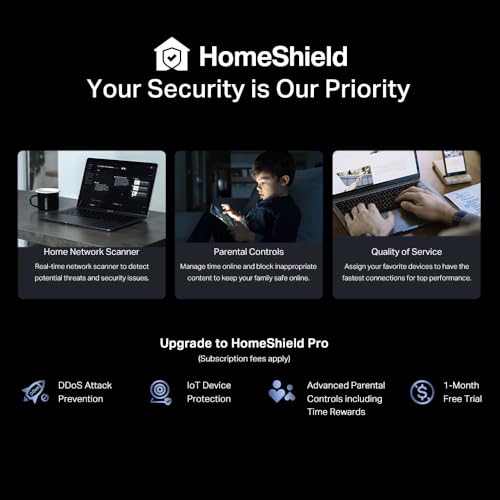
The router runs on a TP-Link Customized Linux operating system and is controlled via a dedicated app. For security, it supports the latest WPA3 protocol alongside WPA and WPA2. A significant commitment is TP-Link’s pledge as a signatory of the U.S. Cybersecurity and Infrastructure Security Agency’s (CISA) Secure-by-Design framework. The built-in TP-Link HomeShield service offers network security scans, IoT device identification, basic parental controls, Quality of Service (QoS), and reporting features. Furthermore, the Archer AXE300 supports functioning as both a VPN server and client, compatible with OpenVPN, PPTP, and L2TP protocols, adding a layer of privacy for remote access or secure browsing. Other noted features include Access Point Mode and Guest Mode.
Setup, Support, and Ownership
Setup is facilitated by a mobile app, and the router is universally compatible with major internet service providers like Comcast, AT&T, Verizon, and Spectrum, though a modem is required for most. The package includes the router, a power adapter, an RJ45 Ethernet cable, and a quick installation guide. TP-Link provides a two-year manufacturer’s warranty. Information regarding the frequency or longevity of firmware updates is not specified in the provided data, which is a point potential buyers may want to investigate further.
Ownership considerations include the advanced nature of the port configuration, which may require technical knowledge to optimize, particularly regarding the 10G and 2.5G WAN port limitations. The router’s high-performance features, such as the quad-band operation and extensive device support, are aimed at users with corresponding needs, suggesting it may be overkill for basic internet use in small apartments.
What Owners Say
Owner feedback for the TP-Link Archer AXE300 is largely positive, with a rating distribution showing 64% of reviews are 5-star and 15% are 4-star. Many users with technical backgrounds praise its performance, highlighting the outstanding Wi-Fi coverage and the capability to handle many connected devices at high speeds. They appreciate the flexibility of the 10G and 2.5G ports for maximizing internet and NAS potential, and some note the advanced networking options like custom subnet configuration that other brands have removed.
Critical reviews focus on two main areas. Some users report that signal strength can drop off noticeably when moving further away or through several walls, suggesting coverage may be excellent but not infinitely expansive. Other critical feedback centers on support concerns, with owners expressing frustration over a perceived lack of timely firmware updates and long-term software support for a router in this price segment, and the paywalled nature of some advanced security features within the HomeShield ecosystem.
Pros and Cons
Pros
- Exceptional multi-band speeds ideal for demanding applications like gaming and 8K streaming.
- Strong wireless coverage and high device capacity suitable for large, connected homes.
- Future-proof connectivity with dual 10G ports and a 2.5G port for high-speed internet and NAS.
- Built-in VPN server and client support enhances privacy and remote access options.
- Advanced security features including WPA3 and TP-Link’s HomeShield with CISA Secure-by-Design pledge.
- Award-winning, robust design with eight high-gain antennas.
Cons
- Advanced port configuration and network settings may require technical knowledge.
- The 10G and 2.5G WAN port options cannot be used concurrently, limiting some multi-WAN setups.
- Signal strength may diminish at extended range or through multiple obstructions.
- Owner feedback indicates concerns about long-term firmware update support.
- Premium security features require a subscription, which some owners criticize at this price point.
- Overkill for users with basic internet needs or small living spaces.
Who Should Buy It (and Who Should Skip It)
The TP-Link Archer AXE300 is an ideal fit for power users with specific, high-demand network requirements. It’s perfect for large households with many simultaneous users and smart devices, gamers and streamers who need low latency and high bandwidth, and professionals with home labs or creative workstations that benefit from 10G LAN connections to NAS systems. It also suits users who value advanced network control, such as custom subnet configuration, and those prioritizing integrated VPN and security tools. For more on routers that handle heavy traffic, see our guide on the best routers for multiple devices.
This router is not the best choice for everyone. Users with basic internet plans (under 1 Gbps), small apartments, or simple needs (browsing, light streaming) will find its capabilities and cost excessive. Those uncomfortable with advanced network configuration should be prepared for a learning curve or seek simpler alternatives. Additionally, if consistent long-term firmware support is a top priority, potential buyers may want to research TP-Link’s update track record further before committing.
Final Verdict
The TP-Link Archer AXE300 stands as a top-tier quad-band WiFi 6E router engineered for the most demanding home network environments. Its combination of a 15.6 Gbps wireless speed, dual 10G ports, robust quad-core processing, and support for over 200 devices makes it a formidable solution for eliminating network bottlenecks. The inclusion of Wi-Fi 6E’s 6 GHz band, comprehensive VPN functionality, and advanced security features like HomeShield provide a future-proof and secure networking foundation. When performance within its effective range is the primary metric, it delivers impressively, as echoed by many technically-inclined owners.
However, its value proposition hinges on the user’s specific needs and technical comfort level. The investment is justified for those who will utilize its high-speed ports, manage a dense ecosystem of devices, or require the low-latency advantage of the 6 GHz band. Concerns from some owners regarding signal drop-off at distance and long-term software support are valid considerations. For users with gigabit or multi-gigabit internet plans looking to maximize their connection, our resource on the best routers for gigabit internet offers broader comparisons. Ultimately, the Archer AXE300 is not a router for casual users, but for the right power user or large household, it represents a capable and feature-rich centerpiece for a high-performance home network.
FAQs
What is the main advantage of the quad-band design?
The quad-band design, featuring one 6 GHz, two 5 GHz, and one 2.4 GHz radio, significantly reduces network congestion by spreading devices across dedicated frequency bands. This means high-bandwidth activities like gaming or 4K/8K streaming on the 6 GHz band won’t interfere with smart home devices on the 2.4 GHz band or other media streaming on a 5 GHz band, leading to smoother performance for all connected devices.
Can I use both 10G ports for my internet connection at the same time?
No. According to the manufacturer’s specifications, the two 10 Gbps WAN/LAN ports and the 2.5 Gbps WAN/LAN port cannot be concurrently configured as WAN ports. This means you cannot use both 10G ports simultaneously for aggregating two separate internet connections. One can be used for a high-speed WAN connection, while the other is typically best utilized for a high-speed LAN device, like a NAS.
Is the TP-Link HomeShield security service free?
TP-Link HomeShield includes a set of free features: Basic Network Security (security scan, IoT device identification), Basic Parental Controls, Quality of Service (QoS), and Basic Weekly/Monthly Reports. However, the manufacturer notes that “premium” security services are available, implying that more advanced features likely require a paid subscription. The exact details of the premium tier are not listed in the provided data.
Do I need a special modem or internet plan to use this router?
The router is universally compatible with all major internet service providers. However, to take full advantage of its 2.5G or 10G WAN ports, you will need both a correspondingly high-speed internet plan from your ISP (e.g., multi-gigabit fiber) and a modem or optical network terminal (ONT) that can deliver those speeds. For most standard cable internet providers, a separate modem is required, as noted by the manufacturer. To explore other options for large homes, check out our selection of the best routers for large homes.
About the author

Elvis Dicki writes reviews and buying guides for CyberSecLabs.